Watching the show trials
Anthony Fauci and the politics of retribution

Over a million Americans died from Covid. I just wanted to mention this data point, because it seems to have been forgotten.
In the early days, we had little information about the nature of the virus. The pace of death outstripped our medical resources. At one point in New York, someone was dying almost every two minutes (four times the normal rate) and bodies had to be stacked in trailers. It was an incredibly scary time.
Yes, you know all this. And yet, it’s become almost a conventional wisdom that the US response was imperfect because it overreacted. “Maybe Fauci meant well, but…”
All institutions are imperfect, and crises expose those imperfections. I think the response to the pandemic does expose real institutional failures, but the greatest of those failures are those of our political system, not our public health system. The pandemic was a global phenomenon, but it seems to have broken the US in a unique way. Other countries had more serious lockdowns without entering a political psychosis.
In a country where conspiracy theories like QAnon are political movements, a real crisis provided the vessel for the worst aspect of American politics. And we are still living the politics of the pandemic. In 2026, Republican politicians are still looking to blame and jail public health officials for the pandemic while accepting no responsibility themselves. This is a version of political leadership that has real costs for public health preparedness.
We are worse off today; that’s not Fauci’s fault
A functional governing system learns from its mistakes so it can do better the next time. Let me ask you: how confident are you that we are ready for the next pandemic?
It seems clear to me the US is less well-prepared that it was before Covid. Trump has stripped away pandemic early warning systems that USAID enabled, and gutted public health capacity, replacing experts with cranks. Elected officials in the governing party claim that the vaccine killed more people than it saved.
But the biggest problem is that there no longer seems to be the sense of collective trust that will enable a society to work together during a crisis. You can choose to think that collapse in public trust is the result of the failures of Fauci and other public health officials. You don’t have to agree with every aspect of the response, but it is reasonable to acknowledge we sit today with the benefit of hindsight.
But you don’t get hindsight with the next crisis. You have to choose which officials to trust. You know that the next public health response will also be imperfect. But in what direction?
Right now we live in a world where public health officials are afraid to be fired, or threatened, or hauled in front of Congress. The head of Health and Human Services, RFK Jr., enjoyed lower public trust in his honeymoon period than Fauci did after years of attacks and only appears to be interested in vaccine research that discredits vaccines. The horse tablet promoters have the ear of the president.
At this point, Senators like Ron Johnson, Tommy Tuberville, or Rand Paul can say absolutely insane things, get some clicks and pay no penalty. The insanity has become background noise, mood music for the show trials. By contrast, an 85-year old scientist who dedicated his life to public health is subject to ongoing attacks and potential prosecution.
The behavior that is rewarded will become a greater feature of our society. The behavior that is attacked will disappear. We chase the Faucis from public service at our peril.
We live in a world where people have been repeatedly told not to trust public health advice, even when it is absolutely sound. This is primarily a political problem, and not one of Fauci’s making.
Such cultivated partisan distrust has real world implications. Even during the pandemic, it became clear that more Republicans were getting sick and dying because they were listening to right-wing media sources. It is perfectly fair to note that public health outcomes have to be weighed against other values, but recent research by Elizabeth Elder and Neil O’ Brien points to how unnecessary some of these deaths are.
Before 2010 they did not observe a correlation between political ideology and health outcomes, but this changed, arising from greater Republican distrust in medical advice, greater unwillingness to seek care, even for health issues unrelated to Covid. The authors concluded: “These patterns suggest that growing ideological divides in health behaviours are leaving conservative Americans increasingly vulnerable to preventable health risks.”
The hearing was part political theater, part a prosecution trap
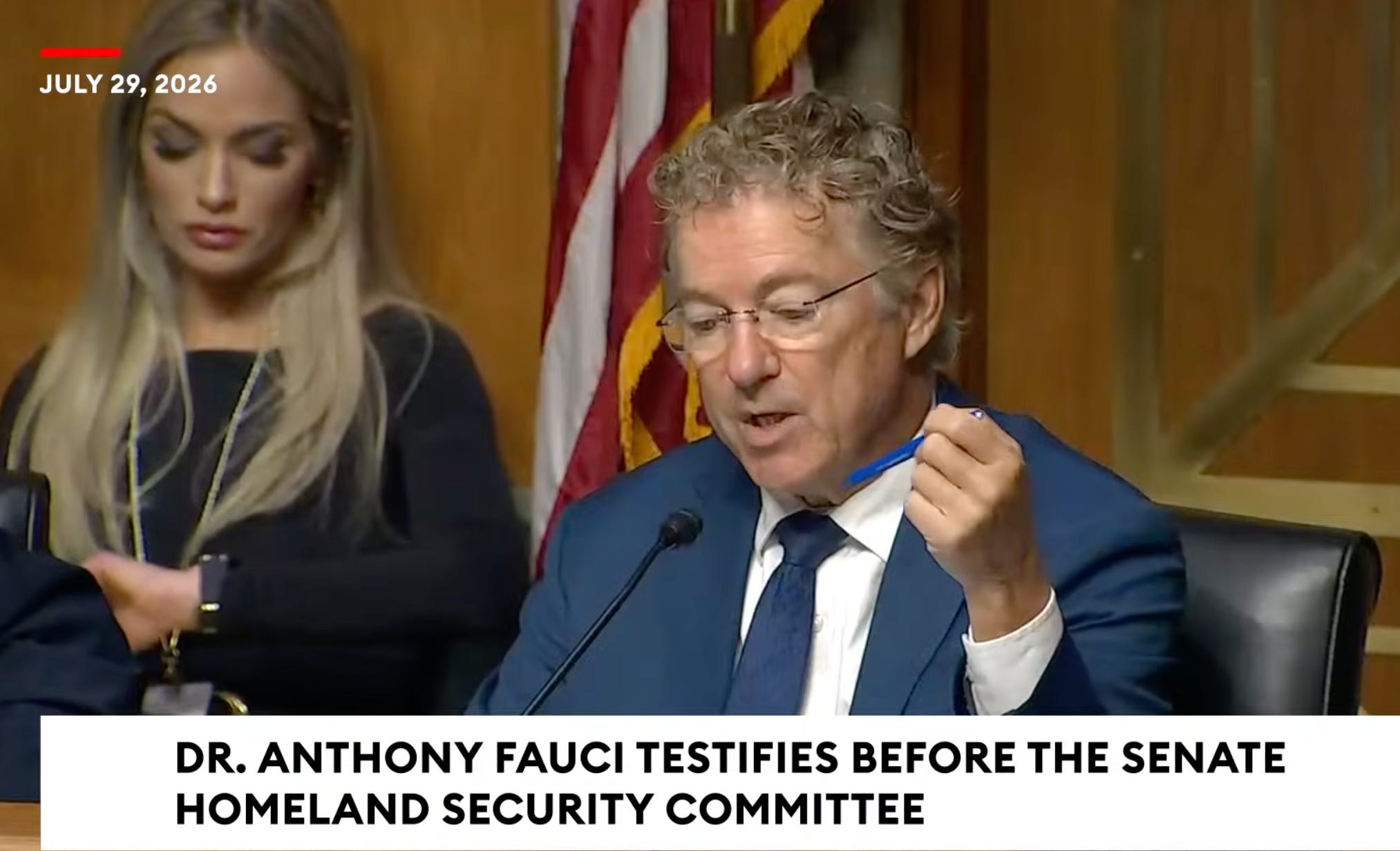
Fauci, long since retired, was the only witness at a Senate hearing. Senator Rand Paul subpoenaed him to appear after Fauci initially declined. Paul also released Fauci’s personal diary, in full.
The diary was presented by Paul as a huge reveal, but it was closer to a nothingburger. What did it show? Fauci grew frustrated with Trump’s rambling or directing him to be positive when thousands were dying. He discussed the lab leak hypothesis with other experts but did not see supporting evidence. There is no evidence of a cover up, as Paul insinuated.
The diary release came after the outgoing Director of National Intelligence Tulsi Gabbard tried to salvage her failed tenure by releasing the “Fauci files.” Again, a nothingburger. Writing at LawFare, Renée DiResta not only debunked the files, but spoke to the same politics of insinuation that Paul relied on with the diary release:
Gabbard’s “Fauci Files" follow the same playbook as her past document drops: Put the desired conclusion in the headline. Use “declassification” as a credibility signal. Present a large, mixed dump of documents as if they were a prosecutor’s exhibit. Convert ordinary government processes—expert consultation, grant oversight, whistleblower routing, intelligence disagreement—into evidence of conspiracy. Then push the accusation on social media, where few people will read the underlying documents closely enough to notice the gulf between the documents and the claims.
And so, both the Trump administration and members of the Senate aggressively pushed claims of a new Fauci bombshells that did not hold up. Never mind, you don’t need evidence for a show trial.
Fauci read an opening statement where he accused Paul of having an "unhinged obsession" with him and described the hearings as an effort to generate material to prosecute him. He was not wrong. While Fauci was preemptively pardoned by President Biden, Paul told Fox News: “If he lies during the hearing, that’s a new lie, and the pardon won’t cover that.”
This is an administration that has prosecuted their political enemies for the most flimsy of pretexts. David Morens, a 78-year old retired Fauci aide and Army reservist, was arrested as if he was a major drug kingpin. A half-dozen armed federal agents wearing bulletproof vests arrested him in front of neighbors, removing his pants and shirt, and forcing him to surrender his passport.
Morens alleged crime? Using private email rather than a government email account, a practice which is routine among Trump officials but deemed prosecutable among their enemies. Don’t hold your breath waiting for Elon Musk or Pete Hegseth be arrested for the same crime.
And so, Fauci has every reason to assume he would be prosecuted on a Trumped-up charge. For the first time in over 200 appearances before Congress, he took the Fifth amendment, refusing to answer questions to avoid the trap that Paul had set for him. Ken White, the first amendment litigator wrote that:
It would be deeply reckless to testify, rather than taking the Fifth, when incredibly dishonest and unhinged partisan fanatics in the Senate are demanding that you be prosecuted and haul you in for a perjury trap struggle session. Don’t hand a spree killer a knife.
Apparently Rand Paul was not happy that Fauci would not cooperate in a partisan effort to send him to jail. He announced that Fauci did not hold Fifth Amendment protections (because of his pardon, which seems like a novel constitutional claim) and would be pushing to hold Fauci in contempt of Congress.
When Paul threatened Fauci during the hearings that there would be repercussions for not answering questions, Fauci’s lawyer tried to respond. Paul refused to recognize him. When ranking Senator Gary Peters tried to use his time to allow Fauci’s lawyer to speak, Paul overrode him, and then ordered the lawyer to be removed by security.
Yale Law graduate Josh Hawley announced “no innocent person pleads the Fifth.” Well, President Trump pleaded the Fifth nearly 450 times in a single case. I’m guessing Hawley won’t be leading the effort to impeach Trump.
At the hearing, Senator Bernie Moreno asked Fauci “Do you feel like you’re in deep shit?" and “Who the fuck did you think you were?" In an interview afterwards, he said: "that was me being nice. That was holding back, trying to be polite given the respect I have for the office." Sounds like a guy not to be messed with!
Also, Moreno’s daughter recently accused her former husband, a Republican Congressman, of physically abusing her including holding a gun to her head. Moreno has not said anything publicly about the matter while the Congressman is running for re-election. His tough-guy act is reserved for retired scientists.
Who would be a public servant in these conditions?
When a crisis occurs, you need competent people. Fauci was one such person. He was an advisor. He did not force Trump or any other policymakers to do anything. And yet, at the hearings, Senator after Senator accused him of being responsible for lockdowns, vaccine injuries and school closures. In effect, Fauci became the scapegoat for every policy decision that Republicans now disagree with. Paul even suggested that Fauci created the pandemic: “Are millions dead because of his experiments?”
Fauci became the face of the pandemic response because he was uniquely credible compared to the rest of Trump’s team. And for that service, he has been threatened and harassed into his retirement. An esteemed medical scientist, he was lectured to by cranks, forced to testify to a group of Senators hoping to send him to jail.
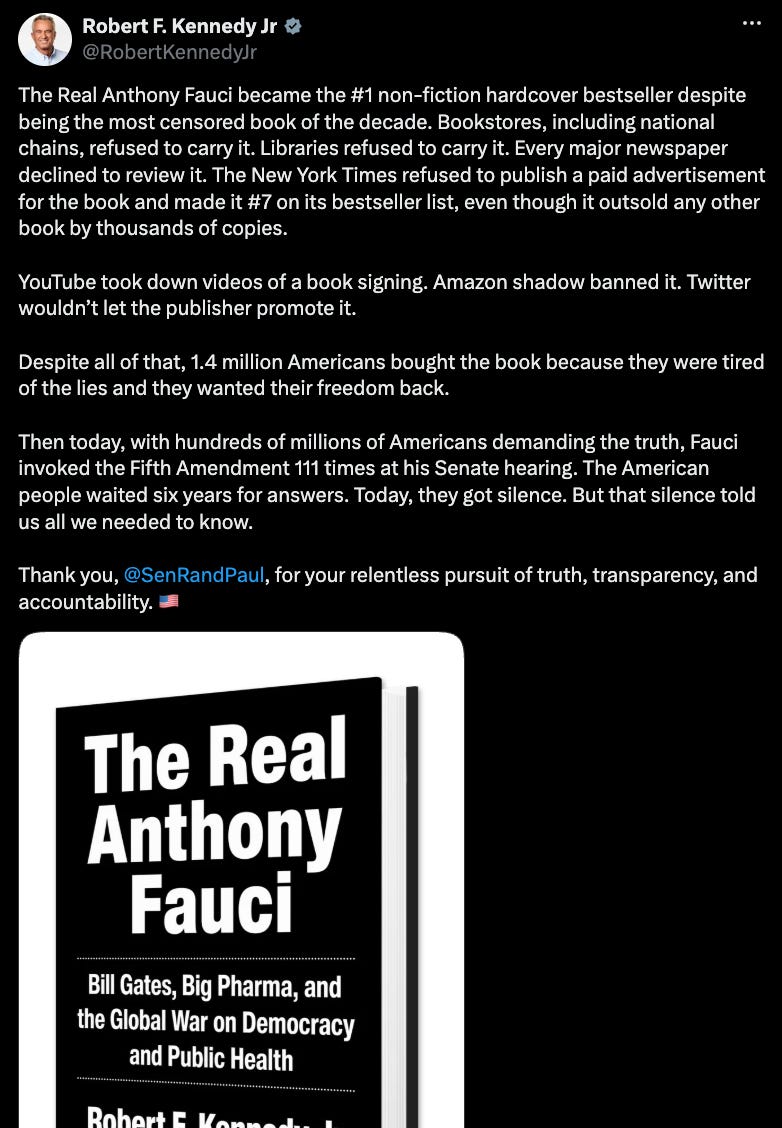
One of the false claims against Fauci is that somehow he was personally benefiting from the pandemic, via some shadowy patents. The truth is closer to the opposite. In a previous hearing, Fauci pointed out that Paul’s website was using Fauci hearings as fundraising tactics. Paul also authored a book called “Deception: The Great Covid Cover-Up” which put Fauci on the front cover. Immediately after the hearings, RFK Jr., who provided Fauci’s diary to Paul, used the attention to promote his own book attacking Fauci.
Meanwhile, Fauci has to live with round-the-clock security protection.
I once met Fauci at Georgetown University. After sharing some pleasantries I chatted with another official, who had also served in the Trump administration. I observed that Fauci seemed to have a lot of bodyguards. He confirmed that Fauci’s protection was closer to that of a former President than a Cabinet official, which was a direct reflection of the seriousness of the threats he faced, which include an armed man who was arrested while traveling to DC planning “to kill Dr Fauci”.
In his diary, Fauci noted these threats:
Threats on the ‘dark web’ [against] me, Chris and the girls. They know everything about us including where my daughters live and work. Strange people hanging around my house and taking photos of the house.
Fauci also noted a lot of the threats came from the far right. “[Highly] tense political situations. I quite frankly do not really care. I will keep doing what I am doing.”
Trump canceled Fauci’s security detail last year. Not on the basis of some careful new risk assessment, but following the logic of retribution that saw him cancel the security protections of others he viewed as his political enemies. Fauci must now pay for the security himself, even as Republican officials drum up the outrage that makes that security necessary.
As a reminder, Fauci was a career civil servant, not a political appointee. When he served, we still believed that the President could not fire civil servants, except for cause. It was also relatively unusual that civil servants would be subject to public partisan attacks that triggered harassment and threats. Fauci worked in government for a long time because he could do amazing, pathbreaking science. Now the President fires civil servants for any reason at all, publicly threatens those he dislikes, and has defunded much of that pathbreaking scientific work.
In other words, this is not just about Fauci, its about attracting competent people to work in a government where they can be deemed expendable or objects of hate by a political system looking for scapegoats.
Senator Andy Kim offered one of the most insightful points from the sorry event:
Right now, I feel the hyper-partisanship growing in this country in dangerous ways. People calling our public servants criminals [is] undermining the very nature of the work of governance.
If you were a smart young scientist watching the Fauci hearings, would you still want to go into government? There will certainly be a time in the future when we need people like Fauci in public health positions. Let’s hope some are willing to help us.
Thanks for this essay. I’m sad but hopeful that this outrageous behavior will be their undoing. Not holding my breath, though. It’s moments like this that I think of historian Joanne Freeman’s repeated reminder that we are living in a moment of extreme contingency. The massive shifts in our society occurred in times such as this—shifted on contingency, the unpredictable.
Did anyone step up to defend Joseph McCarthy's victims? Should they have? Who is similarly positioned to defend Dr. Fauci? Is this happening?