Past the breaking point
The violent occupation of an American city is more than a warning

We use words like “police state.” Then we see it happen. To watch is not the same as to experience it, of course. Of being afraid to leave your house. Or having a classmate, co-worker, or family member disappear. But the images make it more real. It removes any illusion that it could not happen here. It is happening here. We see it happening here, if we are willing to look.
In recent weeks, the paramilitary occupation of the Twin Cities has moved us past some invisible breaking points. About how we expect our government to treat us. And about what might be done about the government agencies that fail those expectations.
Lets step back: the primary purpose of this occupation is the selective use of government power to establish federal dominance over blue states or cities that President Trump dislikes. Thats it. Trump thinks Minnesota is the enemy, and so he unleashed an armed and masked paramilitary upon its people. There is no serious case that this is about the number of immigrants, or some level of violent crime not seen elsewhere. It is about the Department of Homeland Security, in the form of Immigrations and Customs Enforcement, and Customs and Border Patrol, developing their skills as the President’s stormtroopers. It is about making an example of a community.
We are watching ICE and CBP train to become unaccountable
Some remain reluctant to embrace the increasingly popular “Abolish ICE” movement. With better training, and more accountability, they can do their job in a better way. Or so the reasoning goes.
The experience of the Twin Cities shows us the ways that this line of thinking is delusional. Trump previously suggested that military troops could gain training experience in American cities. That is exactly what is happening with ICE and CBP. We are watching them evolve into their logical endpoint on the streets of the Twin Cities. They are learning tactics and practices that they will implement elsewhere. They are testing the limits of their power.
And what are they learning? Experts on the formation of internal security services in authoritarian regimes point to a sense of impunity as a warning sign. Regime officials abuse their power when they know they will be protected, and even praised, for doing so.
Over the course of weeks and months, we have seen images of DHS officials abusing American citizens and immigrants alike, including killing them. What we do not hear is regime officials calling for credible investigations into such abuses, or even expressing any concerns. Renee Good’s killer was announced innocent, and both Good and her wife was instead the subject of an investigation, a perversion of justice so obvious that an FBI agent and half-dozen career Department of Justice prosecutors assigned to Minnesota resigned.
Once DHS agents see and hear the messages of support, and know that accountability is not coming, they feel safe to do whatever they want. How else do we explain the willingness of agents, who know they are being recorded, to do things like directly fire chemical irritants into the face of a subdued individual?
Or to fire munitions directly into the face of protestors, contrary to guidelines on how such “non-lethal” munitions are supposed to be used. One such protestor was permanently blinded.
After the death of Good, the lesson that immigration officials learned was that their actions would be defended, no matter how excessive. The only people to be arrested will be immigrants, citizens who might look like immigrants (thank you Justice Kavanaugh), and protestors. They are the hunted. The immigration agents have been given a hunting license.
Defenders of police abuses will sometimes talk about “bad apples” spoiling the barrel. This is the wrong metaphor for ICE and CBP. The barrel itself is rotten.
The organizational culture and incentives within DHS are encouraging the abuse of power. DHS is recruiting on the promise of playing out white nationalist fantasies with impunity. Once these recruits arrive, these messages are reaffirmed. The norms are becoming so embedded they may already be impossible to reverse.
Lets take a couple more examples of the organizational drive towards abuse. ICE is under a quota of 3,000 daily arrests to achieve a 1 million annual arrest rate target. ICE had previously offered cash bonuses for expedited removals, though removed them after they became public. Now, the Wall St Journal reports that “officers are rewarded for making arrests, even if the immigrants they take in are later released.”
If you have heard of Campbell’s Law, or Goodhart’s Law, or performance perversity, you know where this is going. Give people performance incentives to hit a metric, and they will hit it, by any means necessary, no matter the damage. The organization is telling its employees to round up as many people as they can, regardless of whether they are the type of dangerous criminal Trump says he is pursuing, or even if they are an immigrant at all. And so, indiscriminate round-ups become a part of American life
Constitutional violations have been normalized
It gets worse. Immigration agents are being instructed by Trump officials to violate the constitution. The Fourth Amendment provides protections against unreasonable search and seizures. But ICE agents have been told those constitutional constraints do not apply. A whistleblower revealed a secret ICE memo saying they do not need a judicial warrant to forcibly break into a home.
Notably absent is any legal explanation for this massive change. As a general rule, if a government is justifying constitutional violations with secret memos, you can feel confident that their arguments are not strong. The secret memo was not broadly distributed, but passed to ICE agents via word of mouth and in training even though the formal DHS training materials directly contradict the memo.
In fact, ICE previously told reporters that its agents were being trained on Fourth Amendment rights. The truth is that they are being trained to violate those rights. The law is reflected in formal training materials, whereas the practice of constitutional violations is embedded in the organizational culture and practices.
The distinguished constitutional scholar Steve Vladeck’s response was proportional to how bad the violations are: “I try to avoid hyperbole when it comes to Trump policies, but this is absolutely frickin’ insane—on about eleventy different levels. Massive, systemic Fourth Amendment violations because … reasons.”
The absence of judicial warrants has been a point of tension with ICE on the ground, where many individuals demand to see such warrants, and are handed (if they are offered anything), administrative warrants instead, which are not signed by members of the judicial branch. The idea of a credible judicial ex ante check on abuses of the Fourth Amendment disappears under these conditions.
Of course, if you assume that ICE and CBP never make mistakes, no problem. But lets take an example of how they have made mistakes. At least eight heavily armed immigration agents broke into the home of a Hmong family. They provided no warrant.
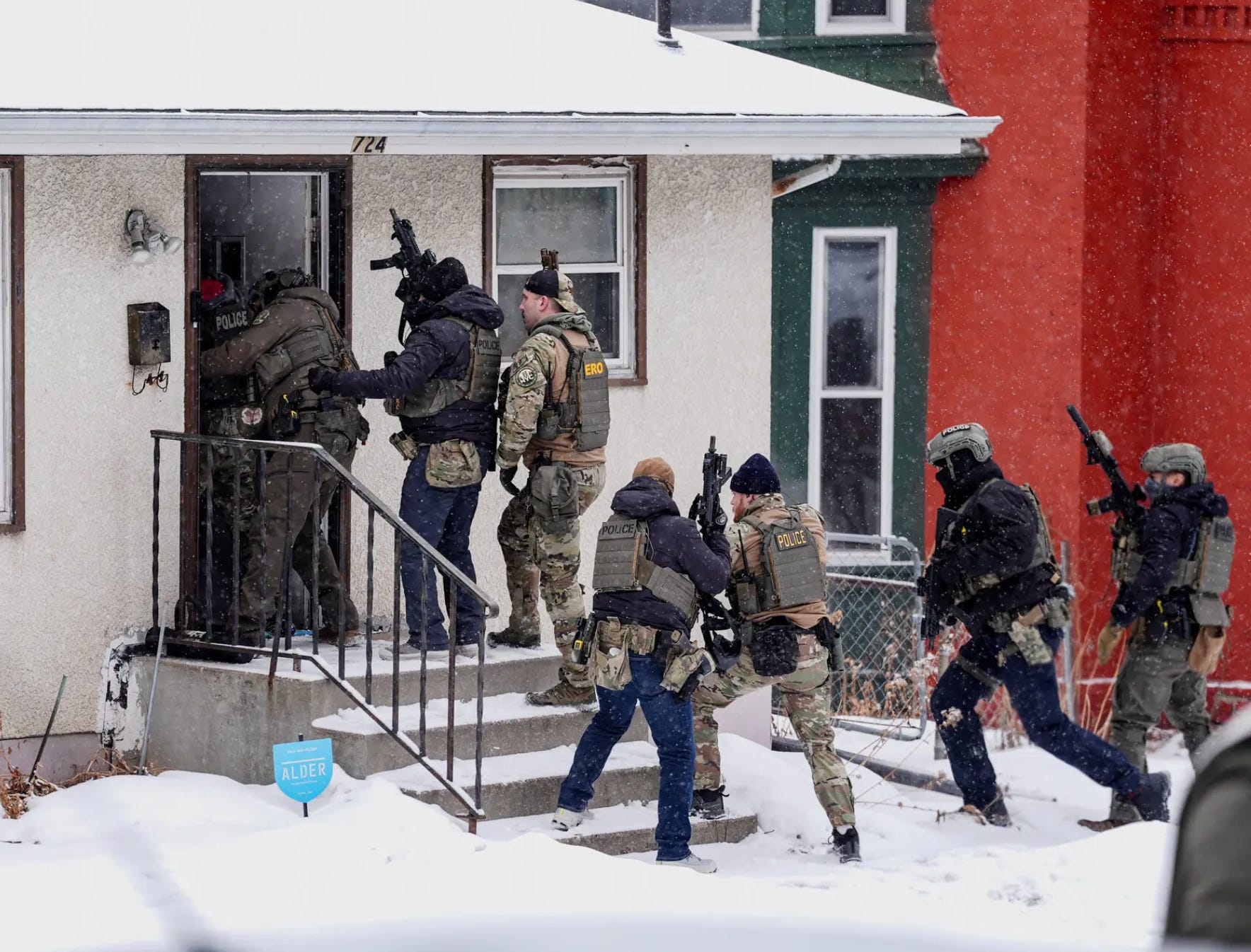
They arrested ChongLy Scott Thao, a naturalized citizen, removing him in sub-freezing temperatures in his underwear while his grandchild watched. His family said they tried to share citizenship documentation, but the agents were not interested.
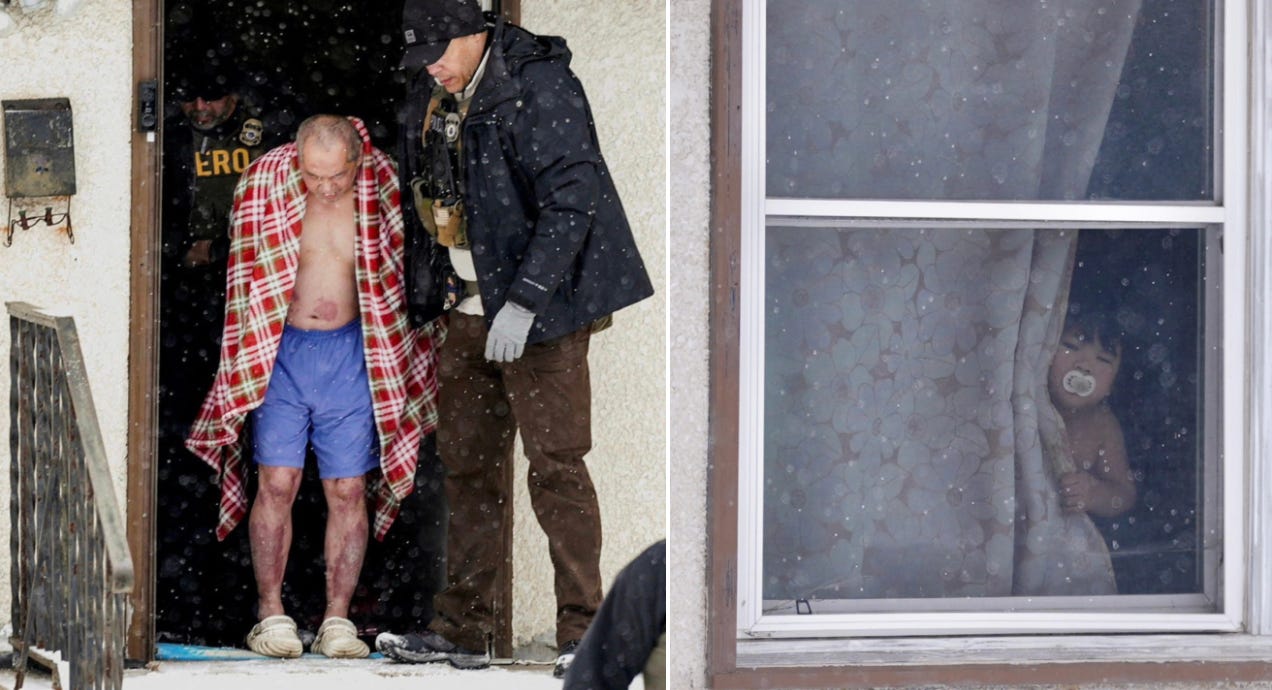
Thao had no criminal record, and the agents returned him to his home after realizing their mistake. But that was not enough. DHS said the raid as part of an effort to target two sex-criminal migrants who they claimed had lived at the address and that Thao “matched the description of the targets.” Apart from being Asian, Thao does not look like the wanted men. The family said they did not know them, and they had not resided there. But anyone criticizing the raid, was, according to DHS, defending sex offenders who were at large.
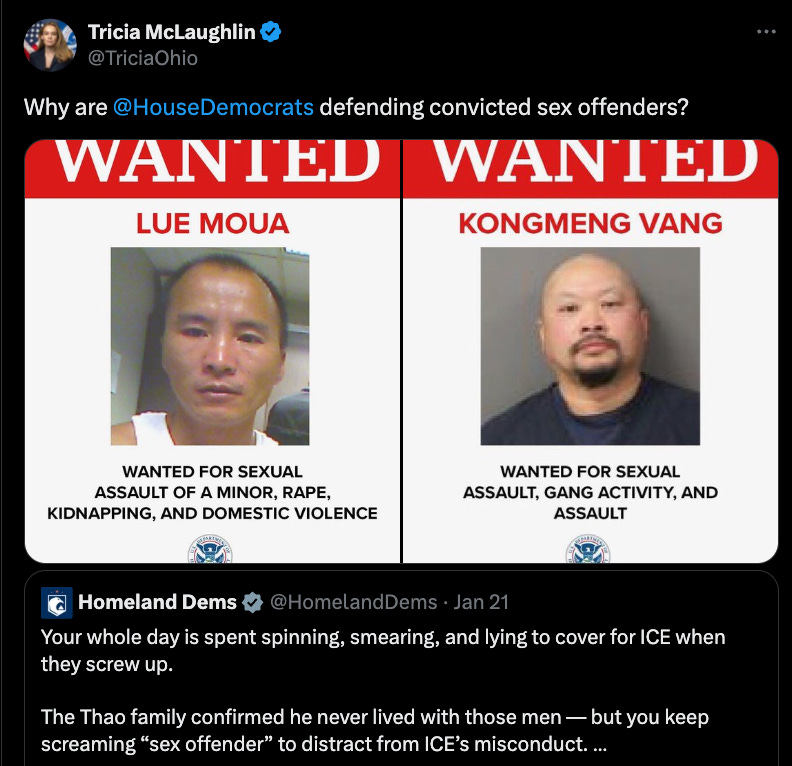
DHS also said they detained Thao because he matched the description of the people they were seeking.

The DHS story fell apart when one of the sex offenders was found…in a Minnesota jail. His presence there was public information. But DHS never bothered to check before they pursued their constitutional violations.
In a normal organization, this sort of royal fuck-up would lead to some serious internal reviews and punishement. And externally, at least, some acknowledgment of the damage caused. But the DHS culture is to never acknowledge error.
They throw chemical munitions into the the van of a family trying to evade a DHS invasion of a neighborhood. Three kids have to go to a hospital and 6-month old child needs CPR. Their response: “It is horrific to see radical agitators bring children to their violent riots…PLEASE STOP ENDANGERING YOUR CHILDREN.”
Another example. Vice President JD Vance defended an operation that saw ICE grab a five-year old child and his father, and then use the child as bait to draw out other family members. While Vance labeled the father than “illegal alien” the reality is that father is a legal asylum seeker who had followed the rules.

This ICE employee got up that morning, put on his gun, his mask, grabbed a 5 year old and instructed him to knock on the door of his home in the hope of arresting a family member. I don’t think better training fixes this problem.
This is part of a pattern where ICE is arresting students, which is causing schools to move to hybrid learning in the Twin Cities as immigrant children risk being grabbed. Families are afraid to go out even for groceries. (One Minneapolis school has warned that ICE is sending out flyers offering food support, with the implication that this could be a means to entrap hungry families).
Subverting oversight
The Trump administration has opposed oversight of the actions of immigration agents. They refused to give members of Congress access to their sites, which is likely illegal. Instead, they have issued subpoenas to state and local elected officials who have been critical of their work in Minnesota. They have inverted democratic accountability into an authoritarian logic: elected representatives are stymied and threaten for seeking to investigate or oppose abuses of their citizens.
At the same time, ICE is telling its employees and prosecutors that observers are “domestic terrorists” and agents have been threatening and even arresting such observers. They also then use software that provides the identity of observers, and telling them that the government knows who they are. Such access of privacy data are only supposed to occur in the context of a criminal investigation. There have been multiple reports that ICE officials will drive past observers homes to intimidate them, and not just in Minnesota. The agents, of course, are typically masked. They do not want to reveal their identity.
From MPR News:
The St. Paul couple followed when eight SUVs filled with masked and armed men peeled out of the parking lot. After failing to shake the observers, the frustrated agents halted their caravan in the middle of traffic and surrounded observers’ cars, threatening them with arrest for impeding law enforcement.
Agents took photos of Levy and other observers’ license plates. Then a masked agent walked up to Judy Levy’s passenger side window.
The agent said: “‘Hello Judith. How are you today?’”
Judy Levy was shaken, but the couple followed when the federal agents’ caravan started up again. That’s when ICE vehicles turned onto Levy’s street. They almost couldn’t believe it.
“Our street is off the beaten path, you don’t go down our street to get to anywhere.” Noah Levy said. “I’d be lying if I said it wasn’t intimidating.”
Welcome to the Clicktatorship
There is a whole research literature about how public organizations work to cultivate a positive reputation among the public and key stakeholders. That logic of reputational concerns seemingly does not apply to the Trump administration. Here, unprofessional behavior is defended. Errors are not acknowledged. Instead, the abuse of the public is viewed as a content opportunity.
Greg Bovino has become the face of CBP because he spends much of his time looking for social media opportunities. According to on the ground observers, Bovino spent a day going from one gas station to another. Why?
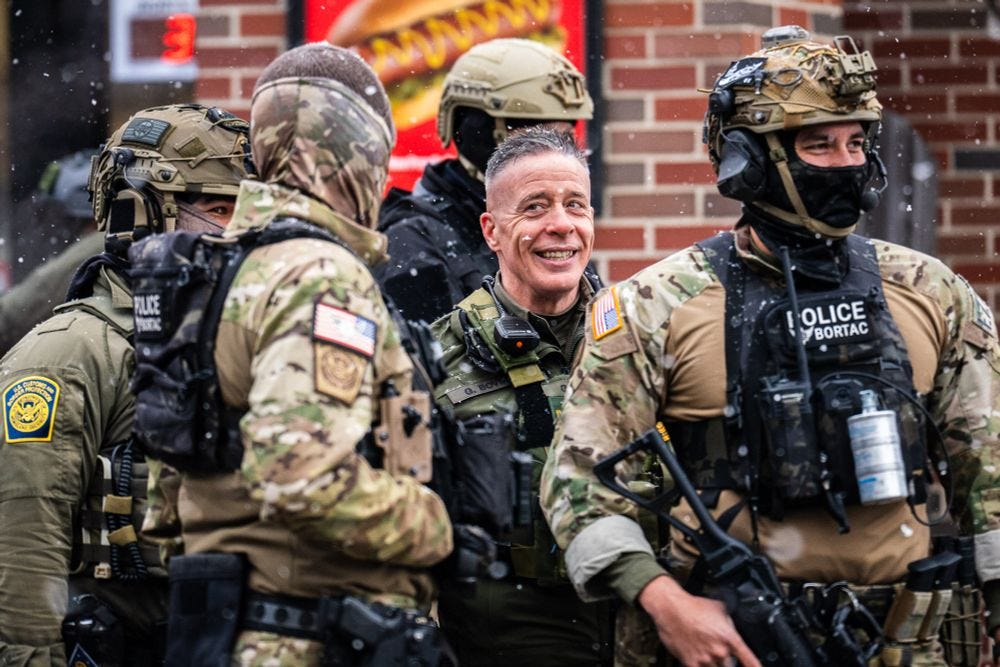
Will Stancil, who has been observing the Twin Cities occupation noticed a pattern:
I was at MANY of these stops. Here’s what would happen: the agents would stand guard at the cars, Bovino would literally pose out front while people yelled at him. It was a pathetic, obvious attempt to antagonize neighbors - they transited three gas stations and did the exact same thing thrice.
DHS presented their agents as the victims of their staged provocations. DHS officials were merely trying to take bathroom breaks they said, when an aggressive crowd menaced them. In one of these encounters, Bovino threw a gas canister at observers, seemingly delighted to take advantage of a new court decision that had stayed a prior decision limiting the use of chemical irritants against protestors.
The Clicktatorhip reached a new and disturbing low this week. After the federal government arrested the alleged ringleader of a protest at a church featuring a pastor who is an ICE employee, the White House posted a doctored image featuring the arrestee crying. The original image is on the right below.
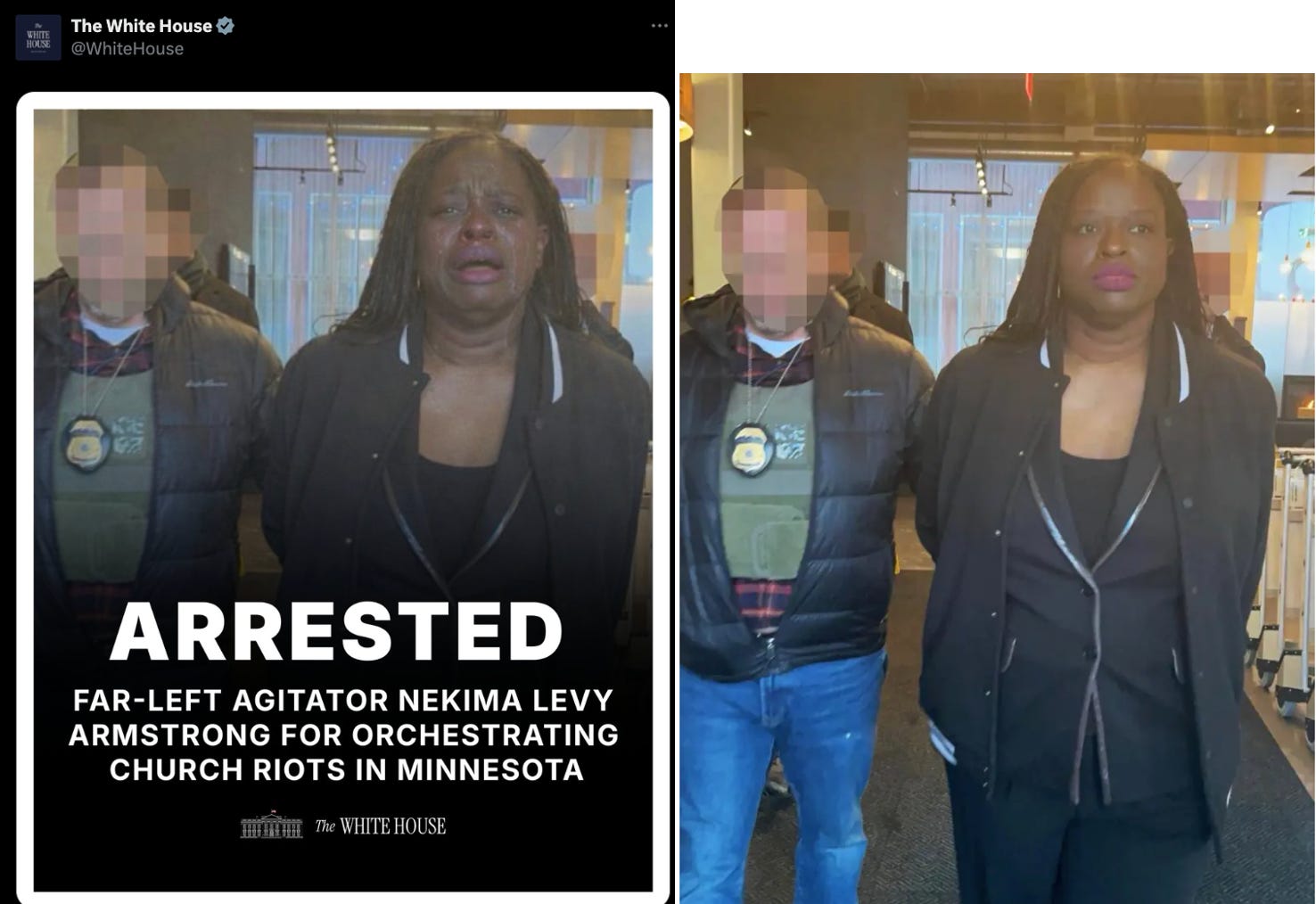
This is the first example I’ve seen of an American government using AI to meaningfully misrepresent actual events with the intent to deceive the public. Drew Harwell of the Washington Post confirmed the fakery, which the White House Deputy Press Secretary mockingly shrugged off: “uM, eXCuSe mE??? iS tHAt DiGiTAlLy AlTeReD?!?!?!?!?!” (Another aspect of the Clicktatorship is that people who have cooked their brains online are promoted to government positions where they have no ability to fulfill basic professional obligations).
DHS has already a track record of lying about public events, and using AI slop in images. Now they are combining the two, using AI to mislead the public by humiliating their political opponents, stripping them of any dignity. A common thread with the image above, and the images of the arrest of the Hmong man, is to create images of degradation and dominance by one means of another. These are the sort of images that the Clicktatorship demands.
As I told Harwell, this moves us “closer to the Stalinesque manipulation of images that we think about with authoritarian propaganda, where you really cannot trust materials the state is putting out."
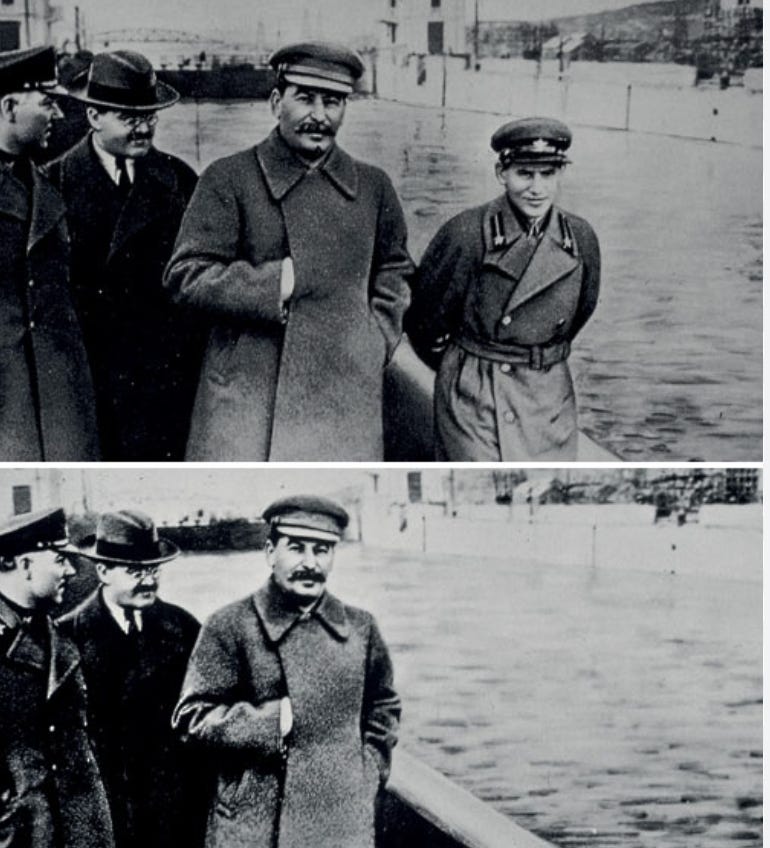
When organizations have normalized this form of behavior, it is hard to imagine how it can be reversed or fixed.
Where are we headed? The essayist M. Gessen reflected upon the erosion of civic space in Russia. Once you could protest, and then, gradually, you couldn’t:
In Russia, mass protest used to be possible…Then mass protest became impossible and the only option was what we called the one-person picket: a person standing alone with a sign. Then people started getting arrested for standing alone with a blank piece of paper, then for “liking” something on social media. Russian journalists used to know that they could write freely as long as they stuck to culture and avoided politics; now a person can get arrested for performing a tune by a banned songwriter.
If you are looking for reasons to hope, take solace in knowing we are not at this point…for now.
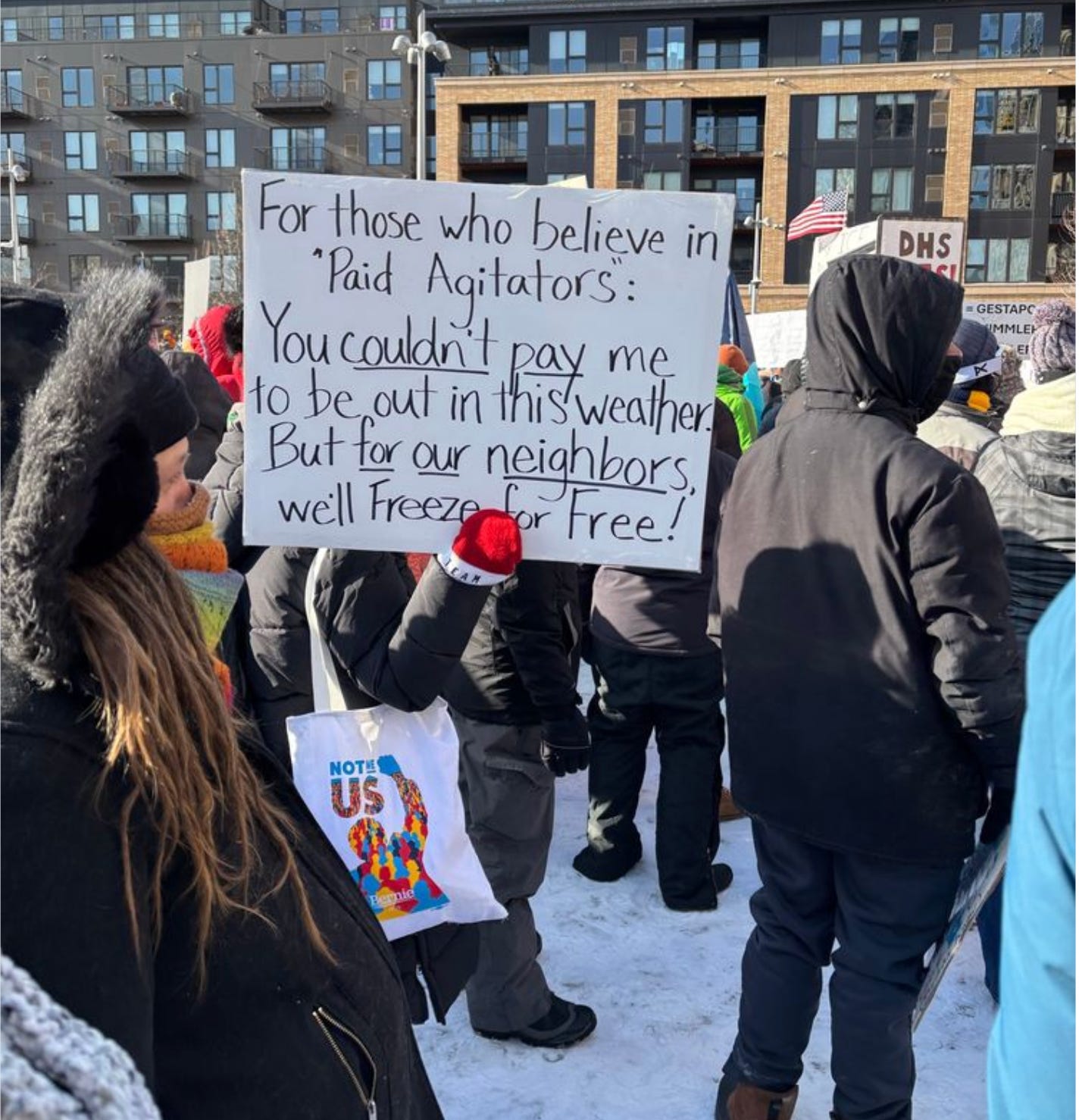
If you are looking for reasons to hope, look to the way that the residents of the Twin Cities have responded. They have shown that American civil society is strong. They have helped and protected each other in the most basic ways. They have shown empathy in the face of hate. They have shown courage that our institutions have lacked. They have peacefully made clear their opposition to a violent occupying force that has abused them at every turn.
America’s founders were deeply opposed to the idea of a distant government maintaining “in times of peace, Standing Armies without the Consent of our legislatures.” Now, as the nation celebrates its 250th anniversary, some citizens raise the same grievance. They, and not their rulers, are the true heirs of the Founding Fathers.
Thanks, Don, for a courageous and candid portrait of the historic events in Minneapolis. It certainly looks like a dress rehearsal for an upcoming tour.