Governing without Accountability
Trump only wants to be President of some of America, not all of America

A huge source of federal power is the distribution of contracts and grants. The Trump administration is exercising that power by limiting the flow of resources on purely partisan grounds, restricting grants to blue states, and offering contracts to cronies. It is the apex of politicization without accountability from a President who only sees himself as governing the people who support him.
We had reason to believe this was happening for a while. Trump has disproportionately cut what he has described as “Democrat agencies” and red state or Republican aligned contractors were less exposed to DOGE cuts.
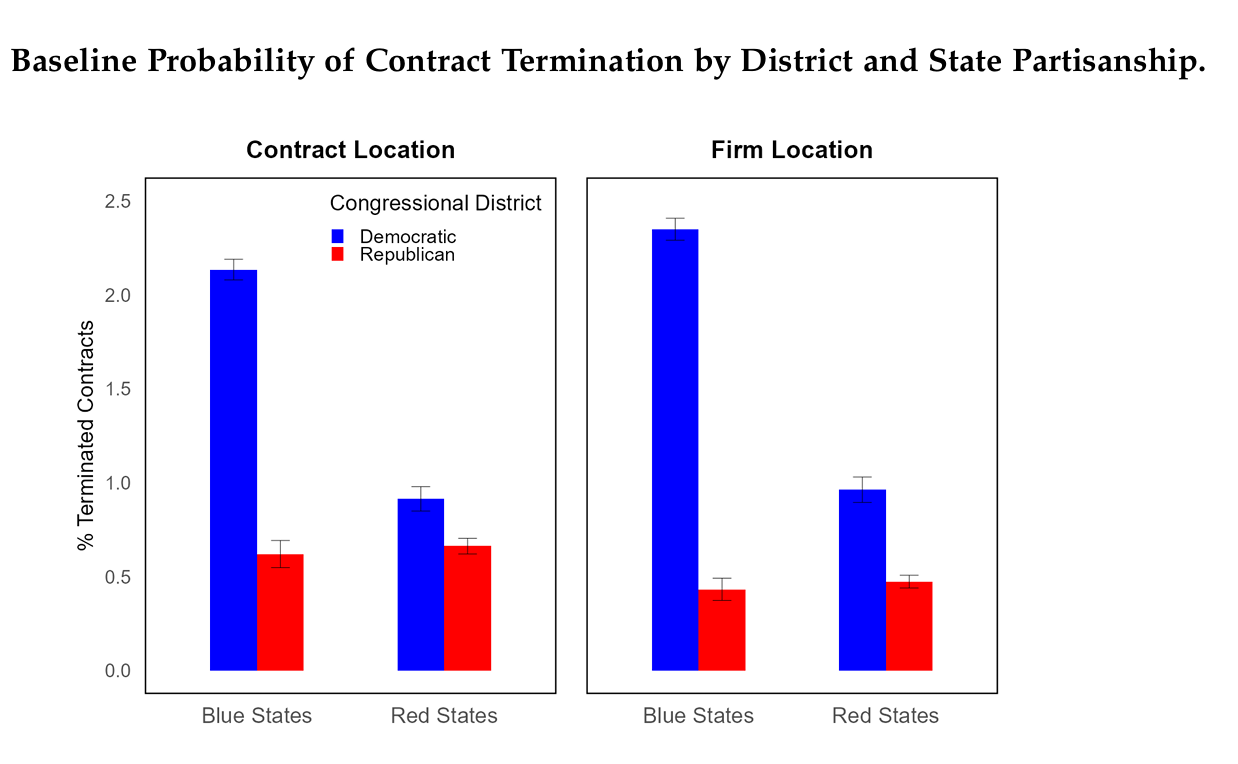
The White House was very upfront that it was cancelling infrastructure projects in blue states during the shutdown to create leverage. Now we have more evidence that this amounts to a policy. Lets take a few examples.
The Trump administration cancelled more than $7.5 billion in Biden-era clean energy grants, saying they were wasteful. But in court documents, the Department of Energy admitted that cancelations “was based solely on the political identity of the grant recipient’s state, i.e., whether the recipient’s location and/or place of performance was in a Blue State or a non-Blue State.”
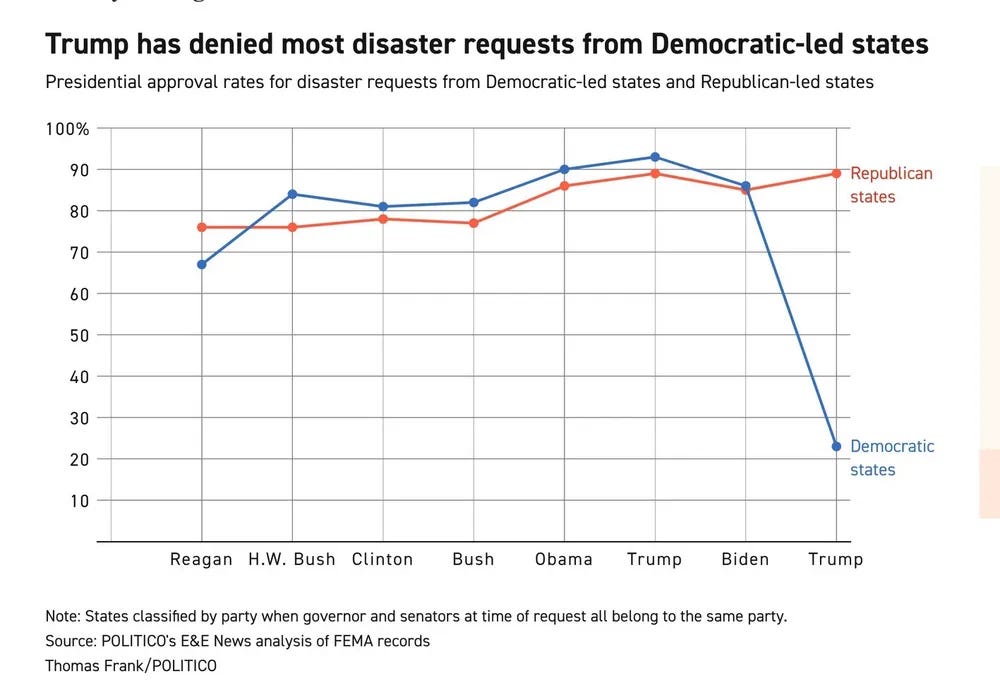
It is now three times harder for blue states to get disaster aid than for red states. Trump has personally intervened to overturn FEMA staff recommendations, blocking aid to states like New Jersey, New York, Massachusetts and Rhode Island. Trump also just denied federal assistance for raging wildfires in Oregon. The provision of aid to red or purple states at the same time came with political endorsements for Republicans. For example, Trump announced federal aid to Wisconsin in the context of his endorsement of Tom Tiffany, the Republican candidate for Governor even though the actual Governor is a Dem.
Is this just business as usual in politics? No. Approval rates of federal disaster aid requests were about the same regardless of the state and did not vary much with the party of the President. This graph very powerfully conveys the scale of the partisan abuses now.
More recent news about FEMA underlined the scale of the mismanagement of the agency. We already know that Trump downsizing did not include any effort to assess the quality of the employees who were walking out the door. A new GAO report found out that the Trump administration did not try to assess workforce needs for the agency. It was fire first, figure it out after.
The GAO reported that “these separations have resulted in a loss of institutional knowledge and experienced personnel, according to FEMA officials, and have exacerbated longstanding workforce challenges.”
It seems like workforce planning is the sort of basic management thing the head of FEMA and its parent agency the Department of Homeland Security should be doing. But Trump’s pick for FEMA head at the time was out of his depth, with no experience in emergency management, and he did little to block the DOGE purges. He lasted for less than six months. FEMA does not currently have an appointed agency head.
From what we know of Kristi Noem, the head of DHS at the time, she was focused on micromanaging some aspects of government operations. Not workforce planning, but — you guessed it — the flow of grants and contracts. Any contract worth more than $100,000 had to be personally signed by her. And some of that spending was pretty questionable, such as a $200 million ad campaign prominently featuring Noem. There was no competitive bidding process and Noem directed money to Republican firms with long-term personal and professional ties to her.
DHS also bought 11 empty warehouses that it said would serve as detention centers, overpaid for them, and has since sold seven of them. Apparently Noem told officials to buy the warehouses within 30 days, leading to a rushed acquisition process. So more likely to be incompetence than corruption in this case.
Noem’s alleged boyfriend/aide Corey Lewandowski was also aggressively shaking down DHS contractors while nominally serving in government as an unpaid appointee. Contractors offered him a retainer, but he declined, wanting a bigger taste. Then he told DHS officials to stop providing them contracts, and their contract success did indeed decline in the following months. Marketing firms were told they were guaranteed a contract, but they just needed to hire a consulting firm who could serve as a pass-through to paying Lewandowski. The consulting firm would get half or more of the contract.
Now, you might know that Noem is no longer Secretary of DHS and Lewandowski is out of government. So maybe accountability is working. But let me make a couple of points. The accountability was driven by external reporting rather than internal controls. The White House had heard the complaints about Lewandowski, but did nothing. The Senate eventually raked Noem over the coals in hearings, but she still has a government job as “special envoy for the Shield of the Americas”, whatever that is.
Things are looking worse for Lewandowski, as an Inspector General investigation confirmed the wrongdoing and may refer him to the Justice Department.
And here I want to spend some time talking about Inspectors General. These are the internal government watchdogs who should be the first on the scene to root out corruption. But they have been neutered.
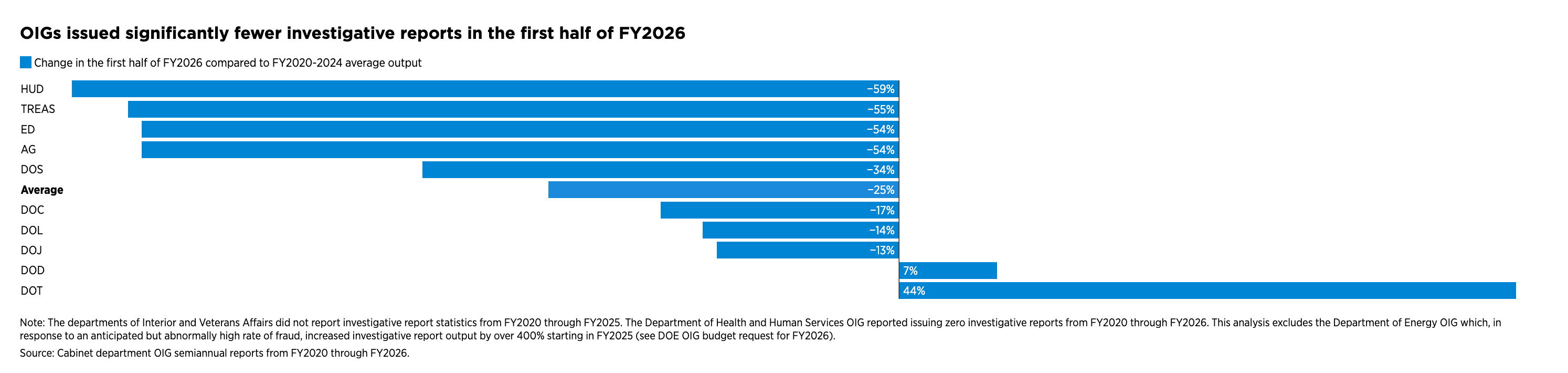
Trump has made clear he will fire Inspectors General who become too active. He has also left leadership positions for these offices vacant and cut their budget. A new report by the Partnership for Public Service finds that Inspectors General offices have been downsized by about 19%. Not surprisingly then, they are providing 25% fewer investigations despite there being much more to investigate. Reports are also taking longer to be published.
What about Congressional oversight? This exists, but it is important to remember that a) this is much less likely to prevent bad things from happening, as opposed to investigate the bad thing after it happened and b) the administration has led a war against Congressional oversight, often refusing to co-operate. For example, OMB head Russ Vought saying that the congressional Government Accountability Office should not exist.
Judicial accountability is possible. For example, the EPA was just ordered to release $20 billion in canceled grants around green energy by a federal appeals court. But appeals are a slow and unwieldy. It requires having the resources to go against the Department of Justice. It can be circuitous. For example, litigants can be redirected to the more limited Courts of Federal Claims. As with Congressional oversight, it is an ex post rather than ex ante form of accountability, which does little to address corruption before it happens, and which is not the subject of a lawsuit. And with the Supreme Court’s ever-expanding notion of executive authority, the end outcome is uncertain. In some cases it might unwind grossly partisan acts, but it will never punish the perpetrators. The incentive structure is that they will win more often than they will lose, so why not keep doing it.
My guess is that there is enormous graft going on in federal contracting right now, which will not be discovered until later. These processes are less visible than grants in some ways. This graft is more likely in the resource-rich national security space, or where there are no-bid contracts because of claims of an emergency (such as, uh, The Reflecting Pool). Contractors aligned with the administration know that speed and loyalty, rather than value for money, is what drives the administration.
In the meantime, we are left with questionable stories where the numbers simply do not add up.
For example, a Texas law firm just received a $150 million one year grant to represent 24,000 children in immigration court. It has 26 employees. And does not specialize in immigration. The firm was co-founded by two Trump appointees.
ICE just paid $2.2 billion to purchase four prisons from a contractor, who will then still run the prisons for them. The whole point of contractors should be that you avoid making long-term capital investments that tie you down.
Maybe these are all perfectly good business decisions. Or maybe not. In the current environment, we have little reason to feel confident that our government is on the level.
While there is often tendency to associate accountability processes with delay and red tape, the Trump administration reminds us that they are there to restrict corruption. Without accountability, people in government will often take a note out of the Tammany Hall model of government by graft, represented in George W. Plunkitt’s classic line: “I seen my opportunities and I took them.”
How many people working in and around the Trump administration right now seen their opportunities and are taking them?
The spectacular irony of course, is that this is an administration that claims to be aggressively reducing fraud.
They have invoked accountability because they know its a public value that people care about. But real accountability is not partisan. Not only is the Trump administration not pursuing cases of corruption closest to home, it is using fraud as one more bad-faith justification to do what it wants to do anyway: cut off funds to blue states.
For example, the Department of Health and Human Services has blocked payments of over $2.76 billion to California and Minnesota. This sort of across-the-board collective punishment of a state weakens critical safety net programs that people rely on. And contrary to what Trump might think, it hurts his supporters. California had almost as many Trump voters as Florida and Texas in 2024.
The Trump administration does not really believe that fraud only occurs in Democratic states. It has enough evidence of corruption on its own doorstep to think Republicans are above such things. What it does believe is that your tax dollars are their tax dollars, available to reward friends and allies, and to be withheld from political enemies, which includes ordinary Americans living in blue states.
Never mind that citizens in blue states already contributed more federal revenue and received less federal funding. Now their residency in a blue state has reclassified them as second-class citizens. The Trump administration has no vision of the collective, of a United States of America, just a Trump States of America.
If you are interested in a deep dive on the Slaughter decision, check out this group of esteemed legal minds (plus me) to unpack what it means from the future. The views ranged quite a bit!
RELATED
What the Reflecting Pool Actually Reflects

Different types of government failures grab our imagination: cover-ups, tragedies, personal moral failings, and corruption all lend themselves to narratives that humans naturally relate to.
Procurement, Capacity and Soverignity
If state capacity is basically the ability to get things done, what does it mean when non-state actors control that capacity? Then, it becomes a question of sovereignty.