Democracies and mutual tolerance
Republicans should reject Todd Blanche out of self-interest

The idea at the heart of liberalism is mutual tolerance. I will not infringe on your rights as long as you do not infringe on mine. I will treat you reasonably when I have power over you because I expect you to do the same when you are in charge.
It is a political philosophy based on reasonableness, and especially suited to a democracy where people routinely disagree. It is also intuitive, so ingrained in human behavior that we take it as a measure for what it means to be a decent person. It is the hard-won wisdom of people who have experienced real oppression: tolerance is a small price to pay to establish the rules in a repeated game that lasts for generations.
In How Democracies Die, Steven Levitsky and Daniel Ziblatt warn that as mutual toleration and forbearance falter, political figures stop seeing normal democratic processes as a means of resolving conflict. Loss of power is presented as so catastrophic that it justifies anything to prevent it, including the abuses of existing power.
The nomination of Todd Blanche as Attorney General is a good illustration of the collapse of mutual tolerance and reasonable pluralism. While the philosopher Karl Popper argued that liberalism rested on intolerance of intolerance, what we have instead is a partisan tolerance of intolerance.
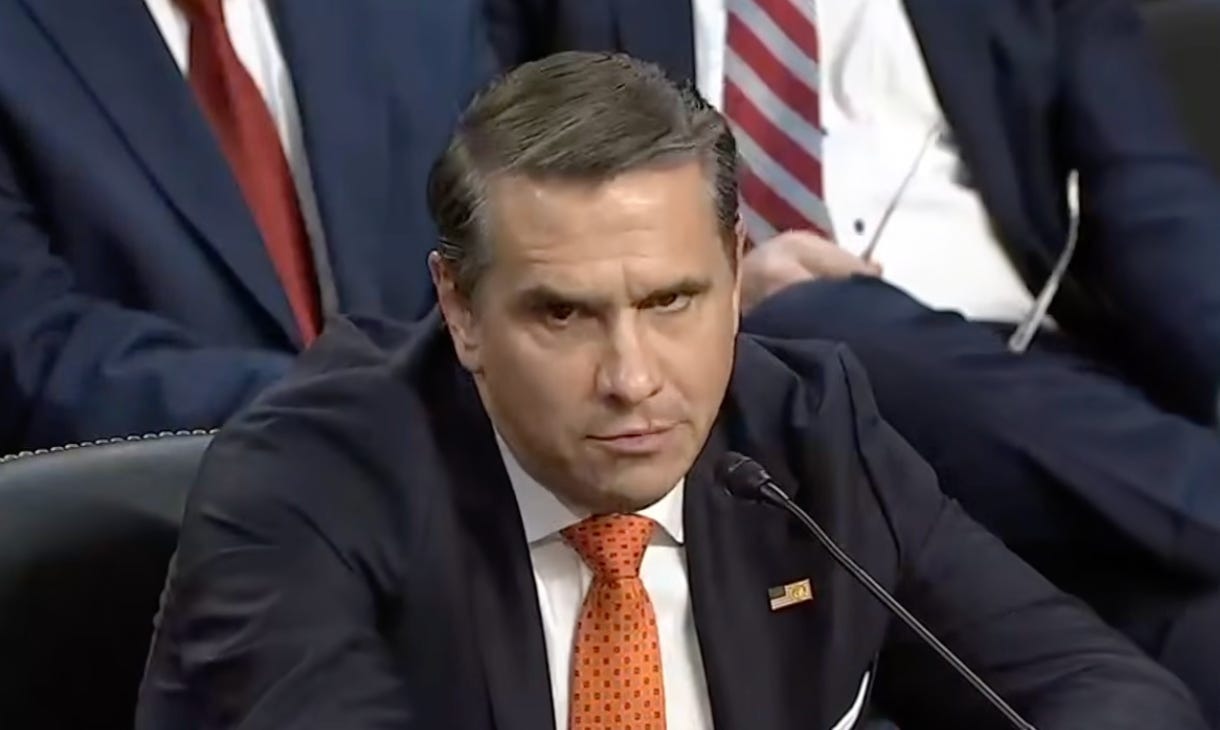
More than any other Trump official (with the possible exception of Russ Vought), Blanche represents the logic of intolerance as a guide to the use of public power: The President must be defended and his enemies must be attacked using state power.
It is not possible for such a conviction to guide your job as Attorney General and to embrace democratic norms. To recap, here are some of the ways Blanche has used the office:
Blanche oversaw the “Weaponization Working Group” that pushed for prosecutions of figures like Senator Adam Schiff, New York Attorney General Letitia James and the Federal Reserve’s Lisa Cook on the thinnest of premises. Blanche oversaw a second prosecution of James Comey for arranging seashells to say “86 47.” He has established retribution against political figures as a new DOJ norm.
Blanche determined the IRS should never again audit the Trump family, while creating a slush fund for Trump supporters to be paid. A US federal judge has scrapped the agreement, for now, because of the obvious “collusion” between Trump and the government he runs, but Blanche seeks to keep the unprecedented protection of the Trump family in place.
Blanche boasted of having “cleaned house” of every FBI and DOJ official who was involved in investigating Trump. Nothing about their performance, merely their willingness to follow orders to participate in investigations Blanche regarded as inappropriate, even as he orders FBI and DOJ officials to participate in Trump’s retribution prosecutions.
There are other ways Blanche is unqualified. He owes his status to having served as Trump’s personal defense lawyer. His legal advice reflects his loyalty to Trump rather than the law: for example, he provided advice that led the DHS to ignore a court order not to remove immigrants.
But it is his willingness to engage in such blatant abuses of power to protect Trump while attacking others that should give the Senators the greatest pause. Even the conservative National Review argued against Blanche calling him: “an instrument of Trump’s unworthy and abusive campaign to investigate and prosecute his political opponents.”
The worst of these abuses — the seashell prosecution of Comey, the IRS settlement — came after the Attorney General job opened up, and Blanche scrambled to show Trump how much more willing he was to abuse the law than even his predecessor, Pam Bondi.
Blanche as a manifestation of MAGA is unsurprising and uninteresting. What is interesting is how Republican Senators respond to someone who is clearly making their future selves more vulnerable to retaliation.
Blanche’s past record leaves little doubt about his future record. His statements in hearings did not reverse the impression of a general directing the President’s retribution. For example in response to the question “Do you believe it is the president’s right and duty to order the investigation or prosecution of his perceived enemies, yes or no?” Blanche responded “I can’t answer that yes or no…he is in charge of the Department of Justice.”
Blanche repeated some variation of the line that Trump was in charge of the Department of Justice and so under the law, Blanche had to follow whatever Trump asked for. Just following orders. In The Bulwark, Will Saletan wrote that “Blanche displayed the sort of personality that serves comfortably in an authoritarian administration.”
And yet…most if not all Republican Senators will vote for Blanche. They take seriously his promise of no political investigations even as Blanche refuses to acknowledge the political investigations taking place today. After the hearing, Senator Tillis, who is retiring, told reporters he was “leaning yes” on supporting Blanche.
If Republican Senators believe what goes around, comes around, why would they support someone undermining the rule of law?
One answer is an assumed asymmetry. Republicans cannot imagine a world where Democrats would nominate an Attorney General who would weaponize the law as Blanche has.
They choose Blanche on the assumption that Democrats will always choose a Merrick Garland — an Attorney General so studiously aligned to the perception of fairness that he investigates the Biden’s son and fails to effectively prosecute Trump.
It may be that Republicans looked at the Biden administration and concluded that there will be no real consequences from the current era. They may be right. But I’m not so sure. The abuses of the second Trump administration are much worse than the first, and the Republican tolerance of it has been higher than before. Under these conditions, the Democrats have many more grievances to nurture, and scores to settle.
The assumption of asymmetry feels like a bad long term bet. Recently Matt Yglesias bemoaned the tendency of Democrats to favor fighters. Whether or not it is bad politics, the rise of the fighter seems like a predictable response to a system where Republicans are engaged in more extreme actions, and moderates seem unable to constrain them. As virtually all present Republicans create an environment where Democratic fighters are empowered, future Democrats are less likely to accept institutionalist like Garland, putting future Republicans in peril.
A second answer is that the MAGA distaste of tolerance, empathy and reasonableness has become so embedded into their worldview and identity that they cannot think of politics as a repeated game.
In no small part this reflects that the MAGA movement and the Republican Party is an extension of Trump’s political id. His art of the deal preaches the virtues of winning, screwing others over, refusing to pay his contractors their fees or his government their taxes because you are smarter than them.
There is also the pre-Trump strain of conspiracism in the American right. If you saw Dwight Eisenhower as a communist agent, you were apt to see enemies everywhere. The paranoid style sat comfortably with racism and xenophobia. Trump has expertly nurtured these grievances, starting with birtherism or his call to lock up Hillary Clinton. In this context, normal political figures become demonized as enemies who must be punished. Imagined persecution become the basis for actual prosecutions.
There are strains of this loss of perspective outside partisan politics but among Trump’s most powerful supporters. Recent essays by Henry Farrell and Tim O’Reilly trace the maddening of Silicon Valley leaders. They no longer resemble the merchant who wanted a government that is stable, predictable and fair, and managed his role in society accordingly. They are beset by a quasi-monarchical mania, where they see themselves as princes whose sovereign powers must be protected, who should not be accountable to markets or governments. They are not anchored in a recognizable belief system such as classical liberalism or religion. They bemoan empathy as the “fundamental weakness of Western civilization” rather than the basis by which that civilization stopped tearing itself apart.
The interregnum between Trump’s first and second terms hardened these views. He and his supporters saw themselves as victims. Indeed, that was a criterion for being part of the inner circle, with the Shibboleth being an unwillingness to accept the results of the 2020 election. The popularization of the term “weaponization” of government came from…Russ Vought, one of the high priests of weaponizing government.
Buoyed by this sense of imaginary victimhood, the Trump administration and followers abandoned reasonableness. They determined that the purpose of power was not to serve the public but to protect (and sometimes enrich) themselves, and to punish their enemies. Every so often, even the claim of victimhood fails. There is no serious claim that Lisa Cook did anything to injure President Trump: he merely wants her out of the way, and Blanche is there to help.
This logic is inconsistent with a liberal democracy, and the role of politics as a means of resolving conflict. And again, it only makes sense either if you think the other tribe will practice forgiveness and forbearance once they return to power, or you think you will never lose power, that your tribe will always be dominant.
Trump is 80 and I doubt he has a long-term view of the world. The Supreme Court granted him legal immunity and his immense riches buy him other legal protections. As president he can preemptively pardon his inner circle and family before he leaves office (and dangle that pardon in the meantime to ensure their loyalty).
Nevertheless, he still seems nervous enough to do all he can to violate norms and even the law to control the outcome of the midterm elections, which includes directing Blanche to investigate debunked electoral conspiracy theories, and telling Americans they live under the a corrupt and rigged election system. Many are speculating this will result in Trump declaring a state of emergency to rig the elections himself.
Republicans can see the polls. They are happy to go along with more gerrymandering, more election restrictions. Mike Johnson, the Speaker of the House emphasized to a conservative audience the centrality of holding power to avoid routine congressional investigations: “I run the protection program. I’ll take care of you.”
This is the ethos of a party that knows it is unpopular and is using the threat of ordinary democratic accountability to motivate its members towards anti-democratic action. It is not the ethos of people confident they can stay in power, as long as basic electoral processes remain reasonably competitive. And by pursuing more extreme actions, they invite an extreme response.
Let me put it in simpler terms. As long as Republicans support candidates like Todd Blanche, they make it much more likely that the next Democratic Attorney General will look much more like Todd Blanche and much less like Merrick Garland.
Unlike 2020, Democrats have looked at other countries like Brazil and Korea, where attacks on democracy have triggered jail sentences for political leaders. In Hungary, the supermajority won by the opposition to Orban is dismantling his seemingly unassailable empire of political, business and media control of society.
We are just 1.5 years into the second Trump administration, and a lot of Americans are angry. There is no reason to assume this will dissipate.
Republican Senators considering voting for Blanche now might tell themselves, my vote won’t make a difference. Because the Senate previously confirmed Blanche as Deputy Attorney General, he can serve as acting Attorney General indefinitely. But in fact this creates all the more reason to take the symbolic vote to oppose him.
Even if the public does not pay attention, their vote sends an important signal to their Democratic colleagues about whether mutual toleration and forbearance till exists. If they vote for someone weaponizing the legal system now, they are encouraging Democrats to do the same when their turn comes around. That is how norms work.