The Trust Trap
What do Jeff Bezos, Bari Weiss, and RFK Jr. have in common?

The formula is pretty simple. People don’t trust this institution, so we need to take charge.
The implication is that once they are in control, they will rebuild trust.
The reality is that those who complain the most about trust usually have no credible plan to rebuild it. Instead, they use distrust as an excuse to pursue an agenda that weakens the institution they lead, further eroding it’s legitimacy. Call it the “trust trap.”
If you work in media, education, or government, you might recognize the trust trap. Some people — such as those working on election administration, public health, or higher education — have heard it a lot from the people who have been actively undermining trust. You are failing, we will fix it. They don’t deliver because they are either clueless or never wanted to succeed.
Lets take three examples.
Jeff Bezos at the Washington Post
Before the 2024 election, Jeff Bezos explained that people did not trust the media:
In the annual public surveys about trust and reputation, journalists and the media have regularly fallen near the very bottom, often just above Congress. But in this year’s Gallup poll, we have managed to fall below Congress. Our profession is now the least trusted of all. Something we are doing is clearly not working.
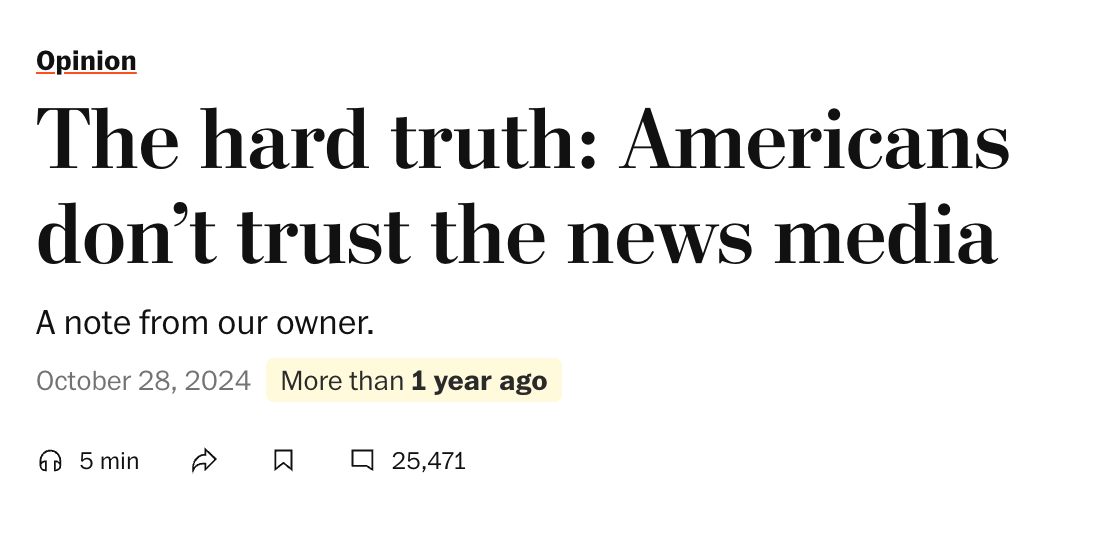
Because of that distrust, the Washington Post, which he owns, had to do something different. Ok. So what was the new Bezos strategy, and how has it worked out?
Bezos wrote his note was to justify his decision, unprecedented in the paper’s history, to spike an editorial page endorsement of a presidential candidate, Kamala Harris.
Bezos then up-ended the editorial board and opinion writers, which had been broadly bipartisan, to now focus on “personal liberties and free markets.” The long-time right-wing Post contributor Marc Thiessen was more upfront in saying: “We’re now a conservative opinion page.” The editorial board routinely parrots Trumpist justifications in an era of growing authoritarianism. So much for personal liberties.
Most recently, Bezos oversaw a gutting of The Post, firing more than 300 reporters, including entire teams, such as reporters covering climate change. The Post is now about half as large as it was when he bought it, even as his net worth is 10 times greater, at about $250 billion.
In short, Bezos fundamentally changed the Post. Do people trust it more?
No.
Marty Barron, the legendary editor that Bezos hired to rebuild The Post, was explicit about how his former boss has undermined trust.
The Post’s challenges, however, were made infinitely worse by ill-conceived decisions that came from the very top —from a gutless order to kill a presidential endorsement 11 days before the 2024 election to a remake of the editorial page that now stands out only for its moral infirmity. Loyal readers, livid as they saw owner Jeff Bezos betraying the values he was supposed to uphold, fled The Post. In truth, they were driven away, by the hundreds of thousands. The owner, in a note to readers, wrote that he aimed to boost trust in The Post. The effect was something else entirely: Subscribers lost trust in his stewardship and, notwithstanding the newsroom’s stellar journalism, The Post overall…Bezos’s sickening efforts to curry favor with President Trump have left an especially ugly stain of their own. This is a case study in near-instant, self-inflicted brand destruction.
More than 75,000 Post readers cancelled their subscriptions after the recent cuts. An even larger number bailed after Bezos killed the endorsement of Harris, but now the decline feels terminal. Bezos does not want a great paper with a conservative opinion page (like the Wall Street Journal). He seemingly barely wants a paper at all.
Its a remarkable about-turn. As late as 2024, Bezos promised: “The advantage I bring to the Post is when they need financial resources, I’m available. I’m like that. I’m the doting parent in that regard.” Now, he is treating one of the most important American media institutions like an embarrassing child from a previous marriage that no longer fits his lifestyle.
It is not just that Bezos’s investment in The Post is a rounding error on his ever-growing wealth. He now sees it as a risk to that wealth, because it critically reported on a President willing to threaten the Bezos fortune. The refashioning and throttling of the Post is akin to Bezos’s $75 million bribe to the Trump family with the Melania documentary.
Under Trump, Amazon’s tax bills dropped from $9 billion to $1.2 billion even as its profits jumped by 45% to $90 billion. Those are the the kinds of numbers that can reshape people’s political views. But you won’t read about this in The Post, which fired the reporter that covered Amazon.
And here we get to the crux of the problem. There are certainly conservatives and members of the Trump administration who might be pleased with a weakened Washington Post, but they are not going to support the newest version of the paper. The traditional subscriber base of The Post valued in-depth coverage that held their government to account. The Post was the paper that broke Watergate, after all. That base is exiting, and not being replaced by Trump voters.
In terms of trust then, people trust both Bezos and the remnants of the Post less than they did before. Whatever Bezos said about his desire for rebuilding public trust, he has done the opposite.
Bari Weiss at CBS News
Bari Weiss talks about trust a lot. She told CBS staff “I don't want to live in an America where there is no trust in our great institutions” and “trust in mainstream news organizations and the legacy press” is at “historic lows, and it's not hard to understand why.”
Just a side note here: Trust in lots of institutions is broadly declining over time, and the reasons are perhaps less obvious than Weiss will admit.
Weiss might not have the financial clout of Bezos, but she is similarly killing trust in CBS even as she invokes declining trust as a justification for her actions.
She defended her decision to delay the 60 Minutes CECOT prison segment in a memo to employees, saying that CBS News had to do “more legwork” to “win back” the trust of American audiences. She determined the story needed more comment from an administration that had been offered a chance to comment, didn’t, and then didn’t comment again.
So how is this going? Thus far, CBS has been losing viewers under Weiss. Weiss seems to be intent on turning CBS into a version of The Free Press, her publication that has treated wokeism as a far more serious threat to America than Trumpism. The Free Press might be large for a Substack publication, but it is still a niche publication. And the heart of the Free Press was a critique of the mainstream media, not a recipe for rebuilding it.
As CBS viewers suspect Weiss is pulling punches about the Trump administration, they can go elsewhere, but will not be replaced by Fox and NewsMax viewers. A pale copy of the old CBS News or Fox News is appealing to no-one.
Trust in the media may be declining, but neither Bezos not Weiss have shown any real evidence they can reverse it. Indeed, both have better track records at eroding trust rather than rebuilding it. In both cases, the broad suspicion is that their actions reflect a desire of corporate media to better serve the consolidation of wealth that is happening under a President who has promised a Putinesque oligarchy to tycoons who stay in line.
To win the favor of the Trump administration, CBS paid Trump $16 million dollars on a phony bias claim, pushed Stephen Colbert out the door, accepted a Republican “bias monitor” to approve their programming, and is now cancelling interviews with Democratic candidates. Weiss is not responsible for these decisions, but she symbolizes that ecosystem, the handpicked choice of the new owners of CBS, the Trump-supporting Ellison family. Trump has personally praised that choice, saying of CBS News: “I think you have a great new leader, frankly.” As Weiss followed the Bezos route of downsizing the newsroom with multiple rounds of layoffs, there is little reason to expect trust will rebound.
RFK Jr. and public health
Lets take just one example from government. RFK Jr has said “public health system has squandered the trust of our citizens” and that “American people no longer believe the CDC has their best interests at heart” in a Wall St. op-ed entitled: “We’re Restoring Public Trust in the CDC.”
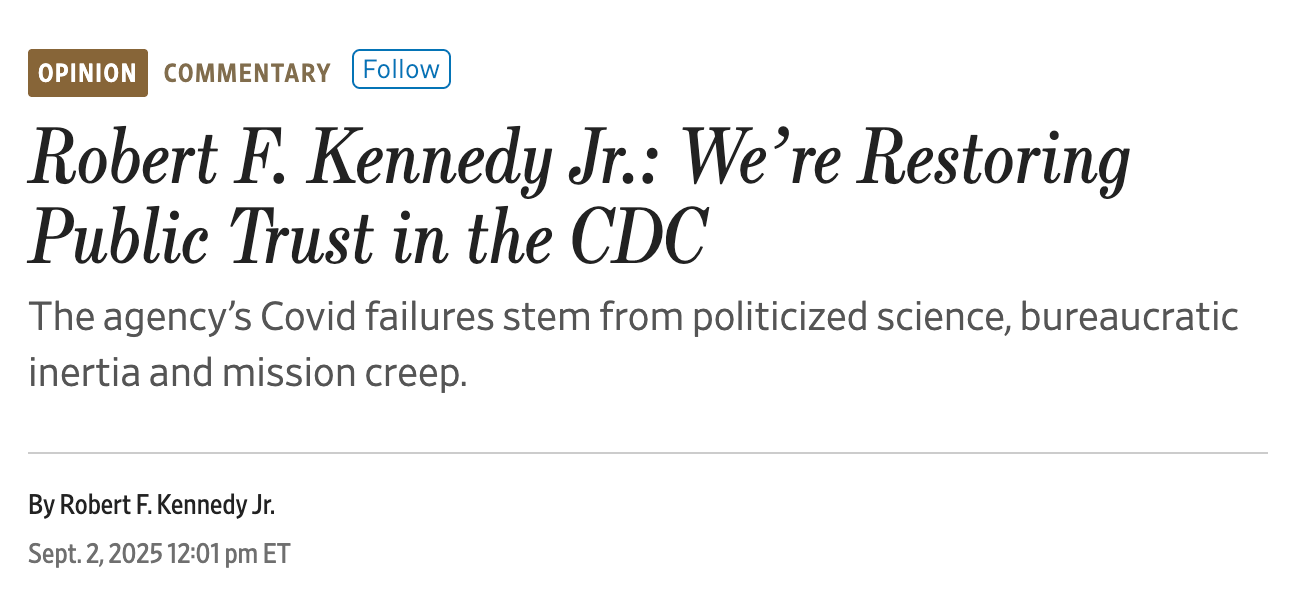
RFK Jr. posted his message about restoring trust in the news outlet of a billionaire Trump supporter as a form of crisis management after he pushed out CDC leadership when they refused to manipulate scientific findings to align with his policies.
So, let me ask you, do you trust the CDC more under RFK Jr.?
Most people don’t. Trust in the CDC had already been declining since the pandemic, mostly driven by Republicans and independents. The decline is continuing under Trump, now driven by Democrats and independents.
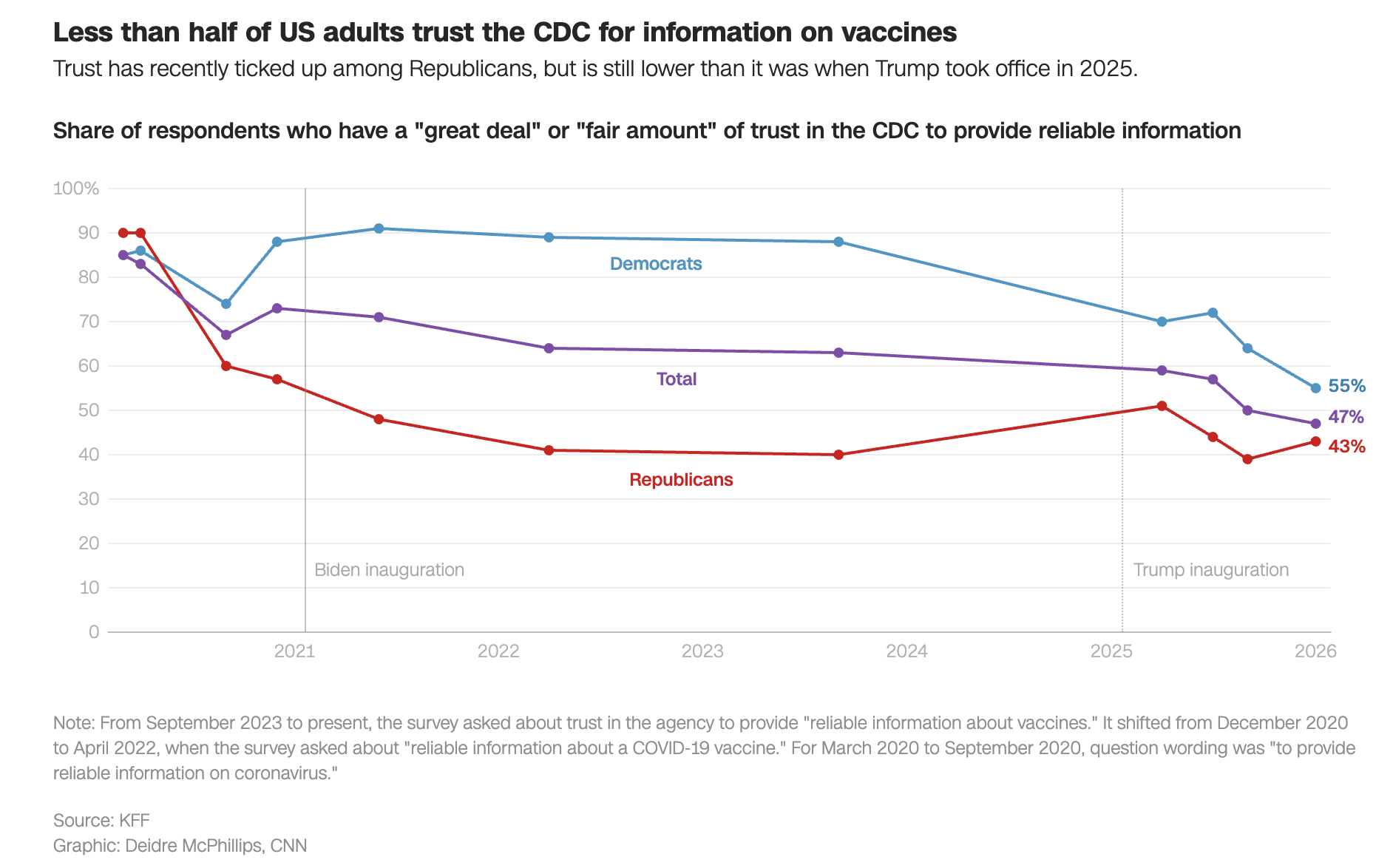
Look more closely at the period before and after Trump was elected, and the large loss in confidence among Democrats and Independents is not offset by gains in trust among Republicans. The most recent polling shows that only 47% of the public express a “great deal” or “fair amount” of trust in the CDC when it comes to vaccine information, a significant decline. Similar post-Trump election declines in trust are happening for the National Institutes of Health.
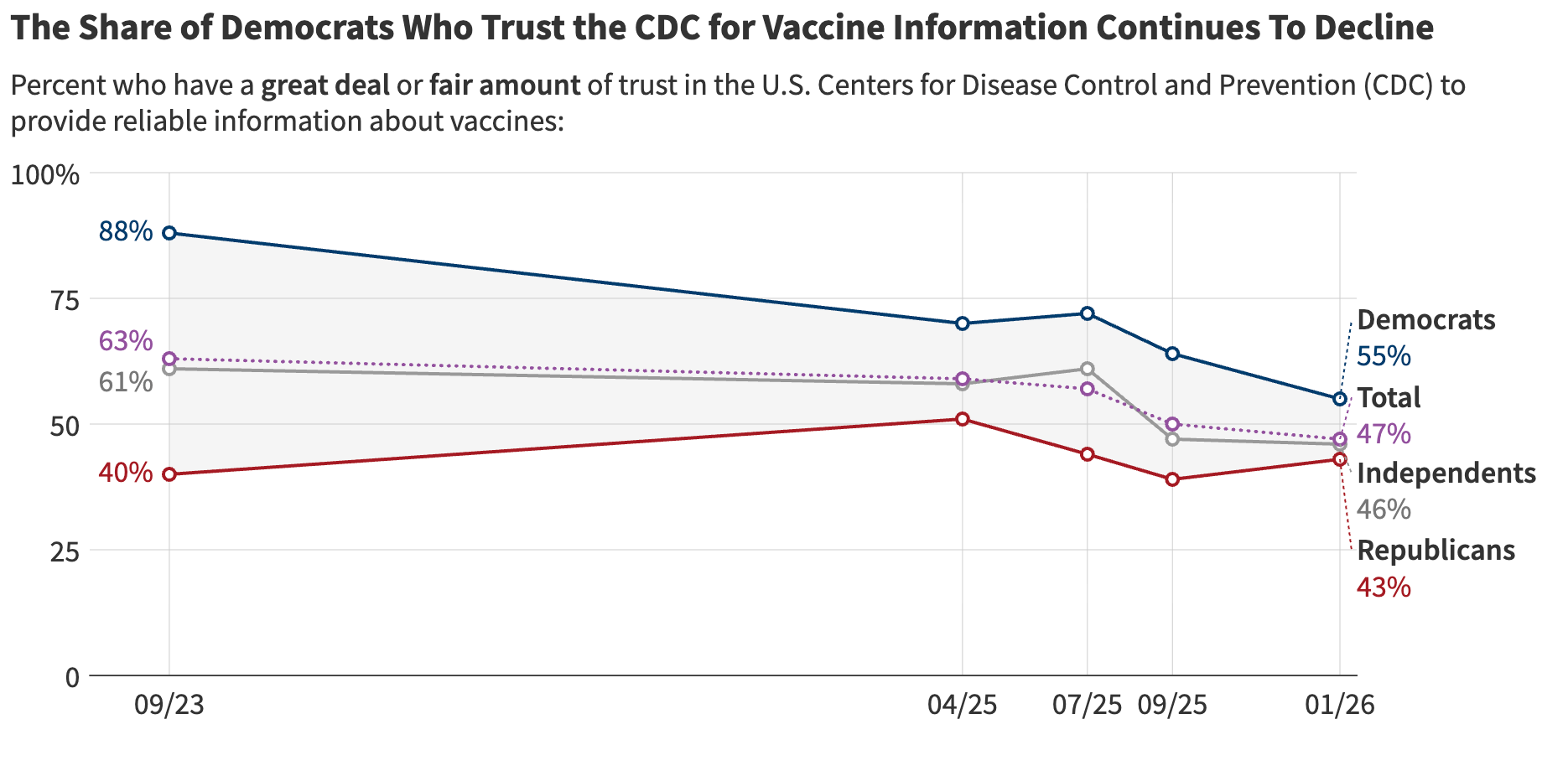
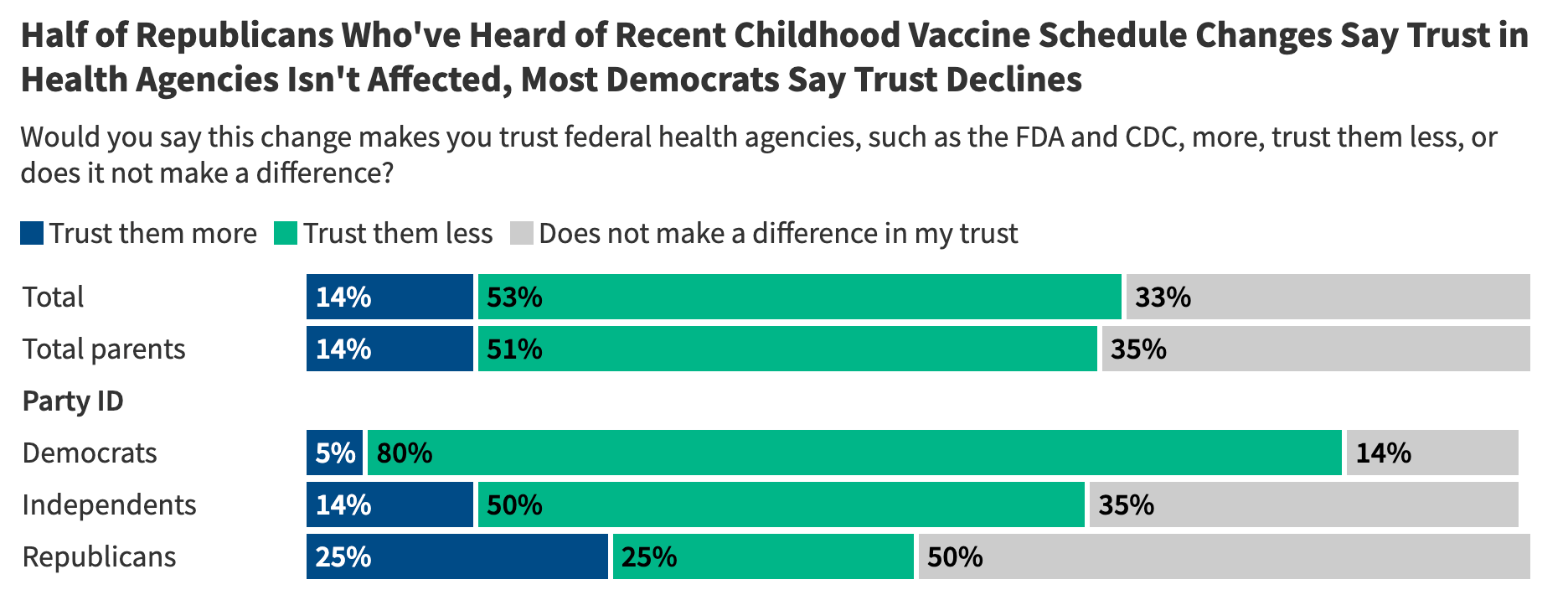
In justifying a new federal vaccine schedule for children, RFK Jr. again invoked trust, saying: “This decision protects children, respects families, and rebuilds trust in public health.” But thats not true. Surveys from KFF, the nonpartisan health policy group, found less than half of Americans trust federal health agencies after RFK Jr.’s changes, including when it comes to making recommendations about children’s vaccines.
The more people know about what RFK Jr. is up to, the less they trust the services he oversees. People who have heard about the vaccine schedule changes are about twice as likely to say they will have a negative impact on kids rather than a positive impact. More than half says it reduces their trust in the health agencies, compared to just 14% who say they trust them more.
Political scientists like Dan Carpenter and George Krause have argued that scientific agencies are especially dependent upon their reputation for technical expertise to maintain public trust. As the technical competence of the organization becomes questioned, and the internal processes of the agency appear to be corrupted by politicization, trust collapses.
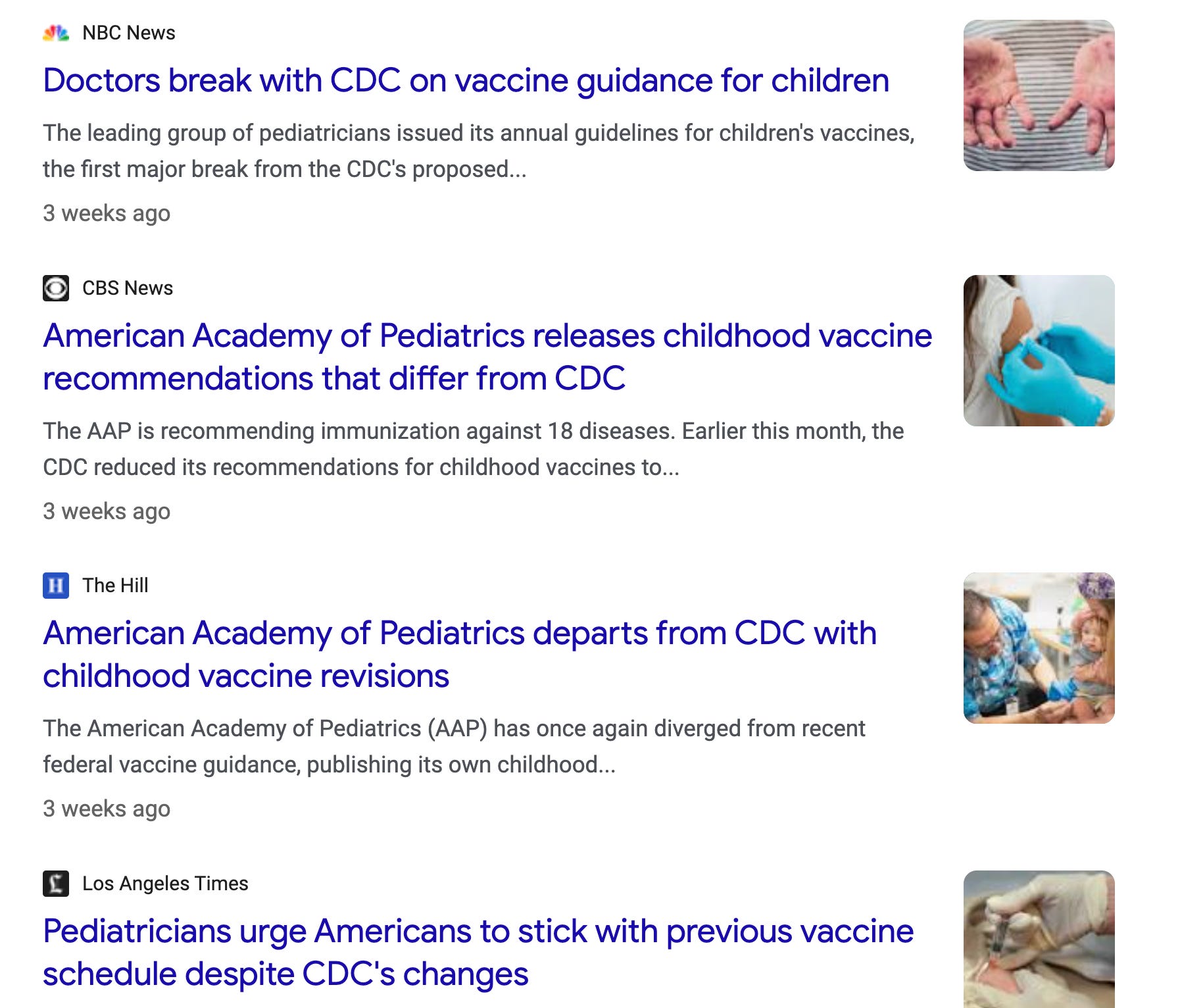
This is a problem for RFK Jr. because lots of credible technical experts can critique his new policies as departing from the scientific consensus. So if parents do their own research by looking at what medical professionals who treat kids say, they will find that the CDC is now out of step with those professionals.
The evidence on the politicization of science under RFK Jr. is plentiful. He purged vaccine advisory panels. The F.D.A. has also initially refused to review new mRNA vaccines, a regulatory stance that fits with RFK Jr’s long-held personal suspicion of vaccines and mRNA vaccines in particular. Federal websites increasingly no longer reflect scientific standards.
Some of RFK Jr.’s views might be classified as “batshit but sincere” but it is hard to ignore how cynical other positions are. RFK has said he believes the chemical glyphosate cause cancer, and was even a plaintiff’s lawyer in a $289 million verdict against Monsato for using products with glyphosate. But when Trump signed an executive order calling for ramping up production of the chemical, RFK Jr. issued a supportive statement. When Trump introduced work requirements for Medicaid for the first time, RFK Jr. wrote a supportive op-ed in the New York Times for a policy that will mean fewer poor people will have health insurance.
It is hard to Make America Healthy Again when you expose people to cancerous chemicals, and then deny them access to health care. And it is hard to trust in the MAHA movement if such blatant hypocrisies must be accepted to keep RFK Jr. in Trump’s good graces.
This politicization of science is not limited to the Department of Health and Human Services. For example, the Trump administration has recently withdrawn the finding that climate change is a threat to human health and the environment. The science has not changed, but the government’s acceptance of science has. Indeed, President Trump referred to climate scientists as “stupid people,” who produced a finding that “had no basis in fact.”
EPA Commissioner Lee Zeldin doesn’t bother to pretend he is engaged in some project of trust restoration. In this respect, he is at least more more honest than those setting the trust trap. He is not exploiting the good will of people who actually care about institutional legitimacy, and are willing to respond to the concerns of their critics. Indeed, when EPA employees wrote a public letter stating that Zeldin was undermining trust in science and the EPA, they were put on administrative leave.
The conspiracists cannot persuade the institutionalists
When Bezos justified the need for The Post to regain trust, he inadvertently acknowledged the cross-institutional nature of declining trust, and the impossible standards that institutions must now live up to.
Let me give an analogy. Voting machines must meet two requirements. They must count the vote accurately, and people must believe they count the vote accurately. The second requirement is distinct from and just as important as the first.
I thought about this last week while I listened to a panel of election officials talk about their work and how it had changed since 2020. They now spend more time working on transparency, ethical training, and communication to rebuild public trust they had no hand in damaging. It is not enough for the institutional actor to do their job well and honestly. They are also tasked with persuading the conspiracy theorist, even though the people who believe elections are crooked are operating in a completely different world.
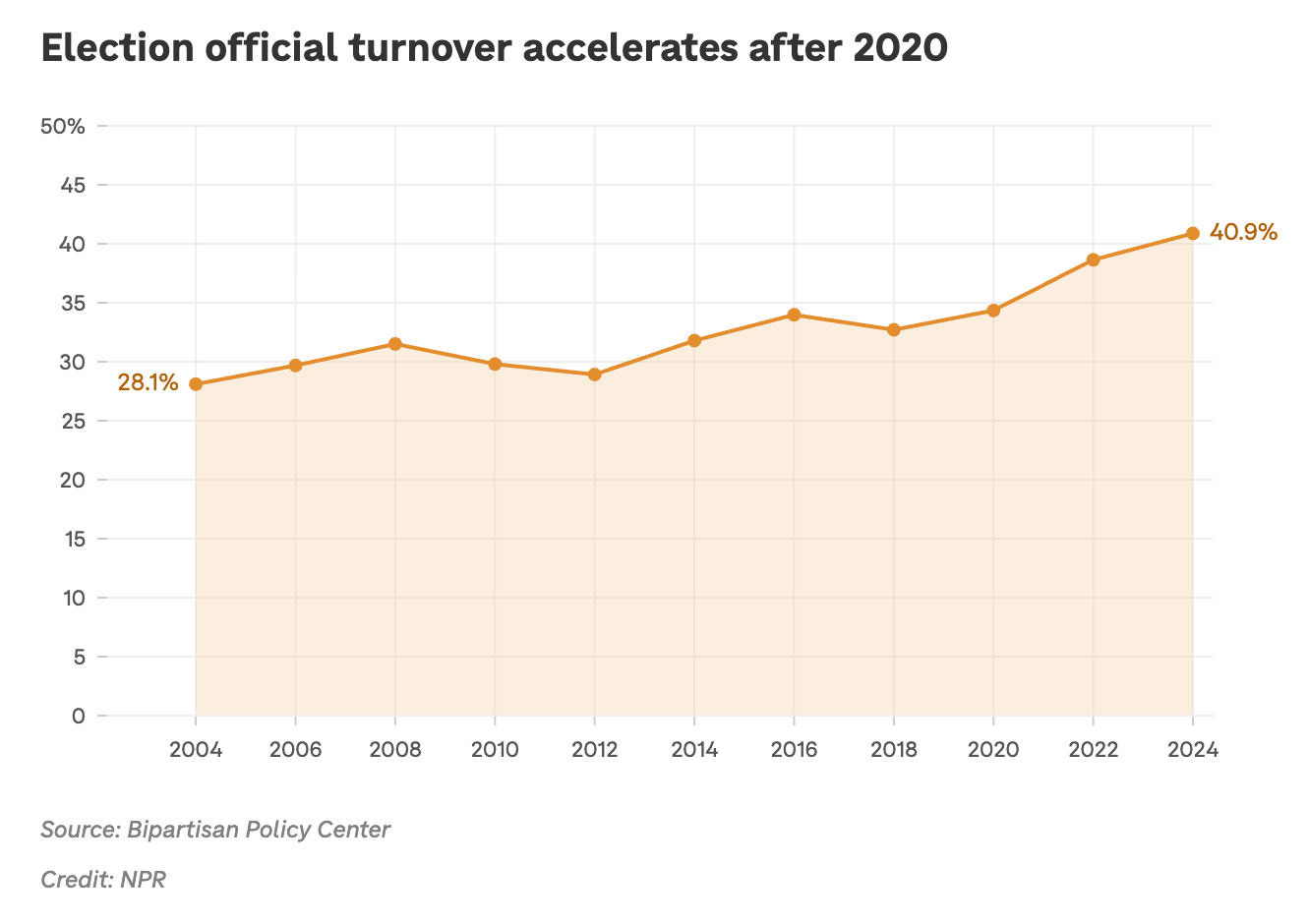
Many have simply given up. About 2 in 5 election officials who were in place in 2020 have left the job by 2024, a rate of turnover that is unprecedented and unsustainable.
Years of independent audits, extensive oversight, and transparency: none of this has been enough for election deniers. The well has been poisoned. Many Americans believe Trump’s conspiracy theories about stolen elections, even as he threatens to take over elections to retain Republican control of Congress. Trump does all of this, while tossing aside transparency guidelines, ethical norms and accountability standards for his own administration. The actions that actually build trust are not of interest to an administration concerned with maintaining power, enriching themselves and enacting revenge.
My sense is that polarization fuels distrust in a couple of ways. One is straightforward. We are more trusting of government when co-partisans are in power.
But there is a second, more ominous problem with polarization and trust that reflects the Trump era. This problem matters not in a pox-on-both-their-houses way, but in a deeply damaging and asymmetric way: Anti-institutionalists, more likely to be on the Republican side, have fueled moral panics and conspiracy theories about a range of American institutions: education, health, elections and the media to name but a few. They use that distrust to take power. But when they’ve taken charge, they lose the trust of those who valued the institution, and cannot persuade their fellow conspiracists that the institution is trustworthy now. They have salted the earth so that no growth in trust is possible.
The use of the trust trap becomes more likely under the conditions we are seeing now: real declines in trust, strategic attack on institutions, and the consolidation of financial and political power. Under those conditions, those wishing to wrest control from institutionalists need a rationale, and the trust trap provides it.
So whats the lesson? Beware people bemoaning declining trust in institutions. Taking them at face value is likely an error, giving them your help a fool’s errand.
It’s a safe bet to assume they don’t understand the underlying reasons for the loss of legitimacy, don’t have a realistic plan to restore trust, but are using it as an excuse to pursue their preferred priorities. In some cases, the people pointing to declining trust have contributed directly to the assault on institutions as critics, and will further weaken organizational legitimacy as failed stewards of the institutions they are charged with leading. Don’t fall for the trust trap.
This is textbook Firehose of Falsehood, the Russian propaganda doctrine identified by RAND researchers in 2016. It's the refined big brother of dezinformatsiya (disinformation) and a pillar of active measures in general. Steve Bannon proudly brags of "flooding the zone," as if he invented it. Hannah Arendt had them pegged way back in the 50s when she wrote The Origins of Totalitarianism: "The ideal subject of totalitarian rule is not the convinced Nazi or the convinced Communist, but people for whom the distinction between fact and fiction (i.e., the reality of experience) and the distinction between true and false (i.e., the standards of thought) no longer exist."
"As CBS viewers suspect Weiss is pulling punches about the Trump administration, they can go elsewhere, but will not be replaced by Fox and NewsMax viewers. A pale copy of the old CBS News or Fox News is appealing to no-one."
Right! And by exactly the same logic, it won't help the Democratic party to recruit "moderate" candidates who would vote with the GOP on important issues. Republican voters won't be attracted to pale Democrat copies when they can vote for the real thing.