The authoritarian checklist
It is time to admit that America is no longer a functioning democracy

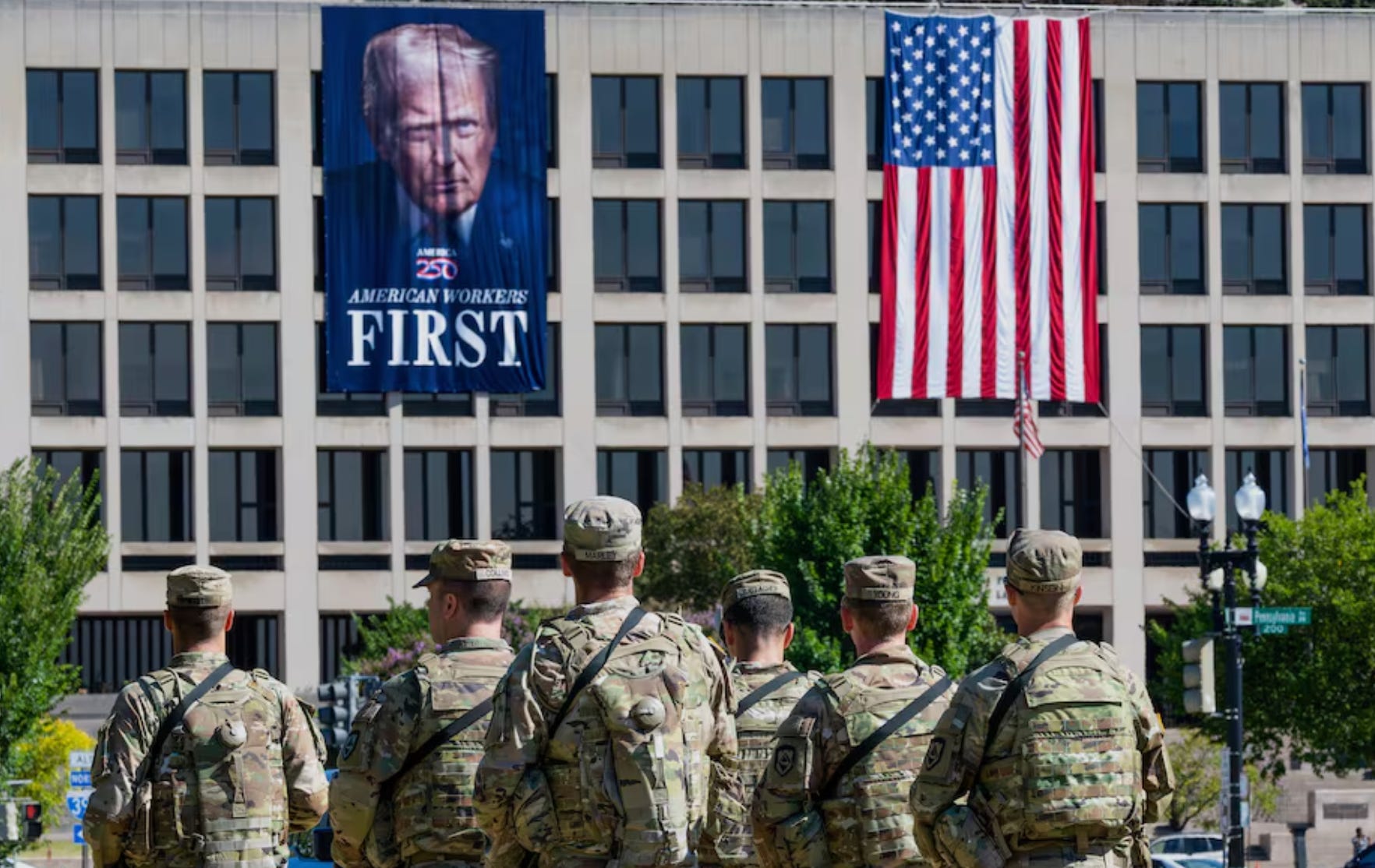
There is so much happening that occasionally pausing to take stock is necessary. So where are we? In deep trouble. America may not be fully authoritarian, but by no means can we consider it to be a functioning democracy.
There will be no announcement, no headline saying “America Not A Democracy.” But if you are willing to look clear-eyed at the cumulative evidence, the inescapable conclusion is that our deeply held beliefs about American democracy no longer match our present reality.
Today, America is a competitive authoritarian system, with a rapidly increasing emphasis on the authoritarian part. The concept of competitive authoritarianism is useful because it suggests that there is not a binary option between democracy and authoritarianism, like a light switch. Instead, democracy can be powerfully degraded even as elections still exist.
If you are an authoritarian, or a wannabe authoritarian, you are inherently driven to follow a specific checklist that allows you to a) consolidate power and b) neutralize sources of dissent.
Here is the authoritarian checklist:
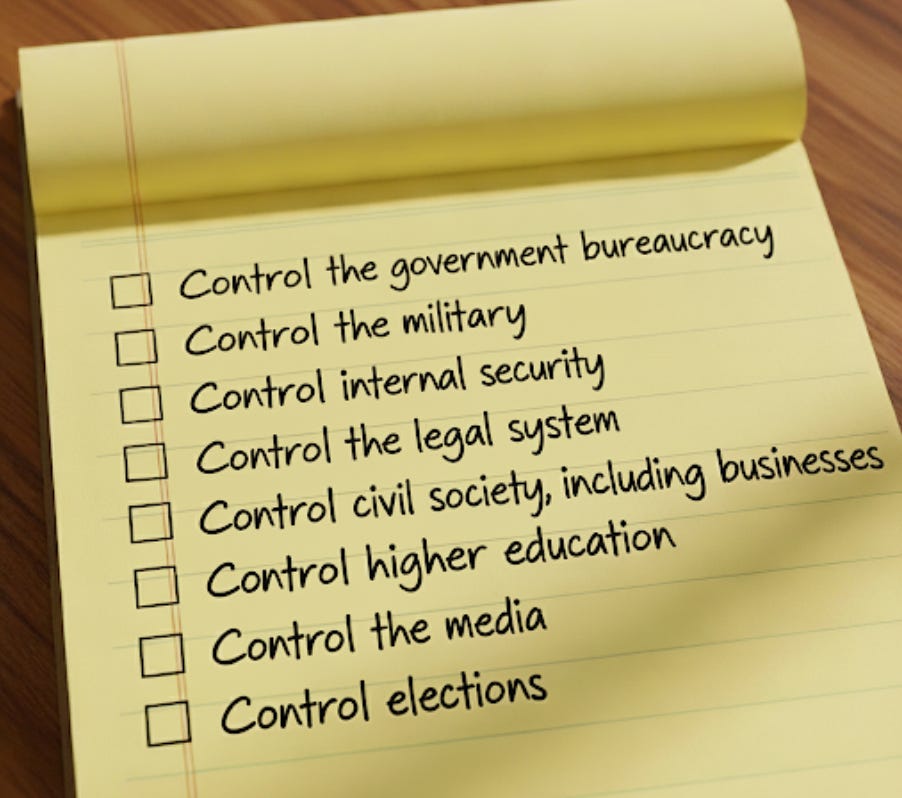
The more that a political leader has ticked off this checklist, the less democratic and free a country is.
What marks Trump’s second term as different from his first is his focus on the authoritarian checklist, systematically pursuing every item. He has made extraordinary progress in a short period of time.
Is this an exaggeration? Lets walk each item on the checklist.
Control the government bureaucracy
The federal government has more than 2 million employees, but only 4,000 are Trump’s political appointees. The rest of the executive branch can thwart an authoritarian, simply by keeping their oath to defend the constitution, following the laws that govern the programs they oversee, which require adherence to democratic values like due process and transparency.
As a result, Trump has gone to war with the administrative state. He has closed agencies and blocked government spending that by law, federal agencies are obliged to spend. Trump has engaged in mass firings and layoffs of government officials, disproportionately targeting staff in federal agencies that pursue progressive goals. One in 8 federal employees will be gone by the end of the year, relying largely on “voluntary” and legally questionable resignation program in the context of threatened firings. It is becoming harder and harder for principled public servants to stay in government and serve the mission of their agency.
Trump’s policies and actions frequently force public servants to choose between following the law or obeying him, but now doing the former will cost them their job. He has claimed the right to remove civil service protections from employees, and is already putting on leave or firing civil servants for simply pointing out violations of laws or communicating risks of mismanagement to Congress and the public. Using a national security rationale, he has cancelled collective bargaining rights. New hiring policies require candidates to describe their favorite Trump policies and how they would serve him. Loyalty to Trump matters above all else.
Many of these actions violate the plain text of laws, and rest on claims that the President has “Article II” powers that no previous President exercised. The Supreme Court seems happy with this explanation, allowing Trump to bring the bureaucracy to heel in a series of decisions, often without any written opinion.
Control the military
American civil military relations have been built around an ethos of mutual respect: military acceptance of civilian control matched by politicians giving the military professional autonomy. Trump violated this norm, purging the most senior generals and now interviewing candidates to evaluate their fit. Nutcases on social media have more influence over who works in key national security positions than military leaders, and key national security talent has been purged. Intelligence analysts willing to provide factual assessments that contradict Trump supporters beliefs are fired.
The military operates on symbolism and stories perhaps more than any organization in government. And the recasting of those symbols have been unmistakable. Confederate names have been reattached to military bases, and confederate statues have been returned to pride of place in our nation’s capital. Women, persons of color, and trans people have been demoted or pushed out of services, and their stories removed from public spaces. Books or courses addressing non-MAGA perspectives have been purged from military academies.
Trump is growing more comfortable with deploying the military to police domestic matters. He has already deployed the National Guard and Marines in Los Angeles to deal with protests against his immigration policies in response to what Trump officials labeled “an insurrection.” Trump has signed an executive order directing the Secretary of Defense to create “specialized units” within the National Guard to focus on domestic unrest. Republican Governors have supplied troops when the President seeks to control Democratic cities.
The past combination of a Secretary of Defense and Chair of the Joint Chiefs of Staff who would restrain Trump in deploying the military against civilians no longer exists. Chicago, the President tells us, is next, even as he makes clear there is no limit to his powers: “I have the right to do anything I want to do. I'm the president of the United States.”
Control internal security
We have an immigration police state. It has become routine to watch masked security agents swipe people from their cars, homes or place of work. Because of Trump budget changes, ICE is now the largest federal law enforcement agency with a budget that would make it one of the largest armed forces in the world.
The police state extends well beyond immigrants. Border Patrol turns up at rallies held by the President’s political rivals in a show of force. The FBI has been purged of any voices seen as untrustworthy by a leader who wrote a book featuring an enemies list. Critics of the President on that list are already subject to investigation, consistent with Trump’s promises of retribution.
If you work in the nation’s capital, you have watched DC being effectively occupied by an ambiguous amalgam of different federal national security and military officers. If there is resistance coming from the various security forces, we have yet to see it.
Control the legal system
While in other countries authoritarians found ways to control the judicial system, the American model of nominating partisans to key positions has already given Trump a leg-up in this regard. Three nominees from his first term provide the basis for a largely acquiescent Supreme Court. That court has in turn weakened the ability of lower court judges to block Trump actions, and judges critical of Trump have faced death threats.
The post-watergate norm of the DOJ maintaining some measure of independence from the President has collapsed. It is now the President’s law firm, focused on targeting his enemies. Career lawyers who worked on investigations of Trump or allies have been fired. His personal defense lawyers serve as both Attorney General and Deputy Attorney General. In their public and private roles, their primary task is the same: defend their client, threaten his enemies or even arrest them. This includes an investigation into the New York Attorney General pursuing Trump, former President Obama, who is alleged to have engaged in a “coup” against Trump, and a member of the Federal Reserve that Trump wants to replace. As detailed below, the weaponization of the DOJ is key to other parts of the checklist.
While we are in many respects a police state, there are clear exceptions. National security no longer closely monitors the President’s supporters. The DOJ domestic threat unit has been effectively gutted. The President’s supporters who staged a violent insurrection have been pardoned, while officials who investigated and prosecuted them have been fired.
Control civil society, including businesses
One reason to feel optimistic about America's ability to resist authoritarianism is the depth of it's civil society. One reason to feel pessimistic is that many private organizations are preemptively folding.
Large law firms representing Trump’s perceived political opponents were a problem. Trump wrote executive orders threatening to punish them unless they agreed to help him. Now they have to provide pro-bono legal support for Trump. while dramatically scaling back both their representation of left-leaning causes. For example, large law firms provided legal support in 2.5% of immigration cases in Trump’s first term. Now it’s down to 0.6%. This neutering of high-capacity law firms strips the targets of Trump’s lawfare from key resources to fight back.
A sense of fear is trickling down to companies who want to stay out of the fray, which ultimately aligns them with Trump. Take one specific example. Ayman Soliman served as a Muslim chaplain in an Ohio hospital. He was in the US legally on an asylum visa after he was able to demonstrate he was arrested and tortured for his work as a journalist in Egypt. Under Trump, his visa was revoked, and he was arrested and set for deportation. His fellow chaplains protested his removal and gave interviews. Cincinnati Children’s Hospital, their employer, fired them for their show of solidarity.
Civil society, and especially corporations, can be co-opted with carrots as well as sticks. Corporate leaders might assume that an authoritarian system is one they can take advantage of, via legalized bribes and flattery. For example, Trump has halted investigations into 165 corporations, one quarter from the tech sector, whose affected firms have invested $1.2 billion in currying political influence with him.
But in exchange for such opportunities, they must abide by a regime where the rule of law and property rights become less certain, a regime that will crush them if they step out of line. In the end, many will find it is not a good trade. Already, Trump has created a scorecard that ranks private businesses on loyalty to his agenda, and has selectively added taxes or taken stakes in certain companies.
Control higher education
Higher education exerts little direct power, but student-driven protests are often the vanguard of movements that challenge authoritarians, and university researchers and critics serve as a source of dissent for authoritarian regimes. And so, the Trump administration has relied on Viktor Orban’s crushing of Hungary’s higher education system as a model to emulate.
Trump has locked up and charged students for protected speech, demand that universities curb protests, and eliminate offices and programs focused on values or topics he dislikes. The administration started with the most well-known institutions, demanding hundreds of millions of dollars in fines.
The unprecedented control over basic aspects of higher education occurs because the federal government has many levers to damage universities. This includes cutting off research funds, federal student loan support, visas for international students or faculty, threatening university tax status, launching DOJ investigations, or even stealing university patents.
Much of this is illegal viewpoint discrimination, but universities calculate that even if they win a court case, the administration can use other tools to punish it down the road. The politicization of the DOJ means a frivolous but potentially ruinous federal investigation is always on the cards. For example, such an investigation provided the justification for conservatives to push out the President of University of Virginia. When a faculty senate protested a similar investigation into the head of George Mason University, the DOJ announced an investigation into the faculty.
While institutions like Harvard and Columbia have received the biggest headlines, the investigations into DEI practices are more broad-ranging, and Trump’s impoundment of scientific funding has been starving all research-active institutions. Authoritarianism tends toward cronyism over merit, ideology over evidence, and threatening rather than rewarding curiosity. We can find historical examples in Spain, Germany and the Soviet Union. Now political appointees rather than subject matter experts have the final say on federal grants, and institutions that are on the list of the disfavored have little hope of fair treatment.
Control the media
Much of the information I am sharing with you is only possible because of the depth and quality of American investigative journalism. The US does not have a dominant public sector news system as other countries do, making the media less subject to government control. In this respect, America has some real advantages over other countries facing authoritarianism.
But Trump has learned to exploit the dynamics of the American media system. He has removed public funding from public media, closing the Corporation for Public Broadcasting. He also effectively shuttered the US Agency for Global Media, which funds Voice of America, Radio Free Europe and other outlets.
Trump does not need to control public media, which is full of actual journalists, because much of the private media is indistinguishable from North Korean propaganda. Almost two dozen members of Fox News have joined the Trump administration, which gives a sense of how connected the two organizations are. Beyond Fox, NewsMax is representative of the breadth of the far right media, which also includes much of social media at this point.
Critical national news media, most obviously the LA Times and the Washington Post, are shrinking their newsrooms as their billionaire owners adopt a more Trump-friendly editorial stance. Media owned by corporations have decided it is in their interests to remove journalists and satirists who are critical of the President, while accepting government commissars to approve of their content.
The fears of such companies are not unfounded. The Federal Communications Commission has harassed media with regulatory threats and the White House appears to have directed state Attorney Generals to sue critical media outlets like Media Matters.
If you read the headlines of any major news outlets how often do you see the sense of urgency that would come from a conscious effort to fight back against authoritarianism? Many headlines are descriptive accounts of how Trump is using power, because American journalists deem that to be the appropriate way to do journalism. Even nominally liberal outlets like MSNBC that feature such voices like Rachel Maddow also feature shows where presenters have gone out of their way to make peace with Trump, and have censored guests for being too critical.
Control elections
Federalism is a powerful bulwark against centralized power. The constitution gives states primary power over functions not directly identified for the federal government. Most critical at this moment is the administration of elections.
But federalism depends upon the federal government respecting the limits of its own power. We can no longer count on this, as Trump treats states differently depending upon their alignment with him. Will blue states continue to receive federal natural disaster assistance? Or, instead, will the dollars they send to DC be sent back to those states in the form of military occupations?
In the crucial domain of elections, elections remain free, their results credible. Here, Trump has made the least progress relative to other items on the checklist. But Trump is pushing red state legislatures to engage in mid-cycle electoral gerrymandering to favor his party, while suing to block blue states from doing the same. The practice of gerrymandering is itself undemocratic, and doing it off the traditional Census cycle underlines that America is a place where the need to prop up an unpopular regime trumps the ability of citizens to choose their representatives.
Trump has sought to use executive power to mandate passports for voting, threatening federal funding to states that don’t follow his directions, and is claiming authority over methods of voting and tabulation, promising to end vote-by-mail. An election denier is now in charge of election integrity at the Department of Homeland Security. He has directed the DOJ to investigate the primary fundraising organization of his opponents.
Other aspects of Trump’s effort to reshape elections are less direct. He has released people who tried to overturn an election, and promised that states will be punished if they do not release his supporters who engaged in election interference. His mainstreaming of of election denialism has fueled threats against election officials, encouraging more to exit the position. A recent survey found that three in five election officials are worried about political interference, and more than half are concerned about workplace safety.
The consolidation of Trump’s power has happened very quickly, more rapidly than we have seen in other examples of competitive authoritarian systems. His success is driven by two factors. First, Trump learned a lot from his first term and had personnel with detailed plans in place for his second term. Second, people in institutions decided to accept the new arrangements. Chief among them is the Supreme Court, which seems content to allow Trump to ignore laws and alter the constitution. At a moment the constitution needs them to be big, the Supreme Court has made itself small.
Many remain unable or unwilling to see the bigger picture. If you think the assault on higher education is about anti-semitism, or that the purge of the federal government is about DEI, or that taking over Democratic cities is about crime, you are helping perpetuate Trump’s rationales for undermining democracy. Pundit brain is very US focused: the points of reference are US left/right, and the Smart Take is always saying the right has a point that the left refuses to acknowledge. This is a huge blindspot when "the point" is a is a bad-faith misdirection to justify authoritarianism. Refusing to see the Trump administration as following the predictable pattern of other authoritarian regimes enables that blindspot.
As residents of a country that has not experienced authoritarianism, Americans remain wedded to democratic thinking. We assume that elections in 2026 and 2028 will fix things. Of course, such elections will matter. But we cannot count on them. We are only seven months into Trump’s time in office, and he is assuredly not finished in his pursuit of the authoritarian checklist.
Accepting that America is not longer a functioning democracy should change how we think about the future. Does America face a decades long shift away from democracy, as in Franco’s Spain, or a quicker rebound? So much is tied to Trump, a 79 year-old man, but the institutional regressions he has pioneered can be used by other actors.
What is very clear is that the moment for a Nixon-style rebuke has passed, because unlike the 1970s, Republicans are all in with their President. A future Biden-style assumption of return to democratic norms, paired with minor legislative safeguards, already looks unrealistic and insufficient. That was tried from 2021-2024, and failed.
A deeper project of reconstruction will be needed, one likely tied to even more intense partisan division and ill-feeling. A new reconstruction to fix the Trump era will likely involve a degree of use of state power akin to Trump’s actions now, which automatically makes liberals uncomfortable.
Caveats: I am aware I am opening myself up to accusations of alarmism. I dearly hope such accusations will prove to be true. But the bigger risk today is to not acknowledge the threats. I have presented them as best as I can, though folks might quibble about the categories, or terminology. I focus on the progress Trump has made, not the resistance by actors in these spaces. Other compelling recent essays on these themes come from Garrett Graff, Christina Pagel, Steve Saideman and Jonathan Bernstein.
The nostalgia for the idea of American democracy can’t blind us to it’s collapse. Americans are less free than they were a year ago, more subject to state power directed by a President disinterested in democratic norms. It doesn’t mean we should give up, or that improvement is not possible. But it is difficult to move forward if we don’t acknowledge where we are.
Cite as: https://doi.org/10.32388/substack.k1go8x • PDF
You are not being alarmist. Historically, countries that suffer the social and cultural crippling caused by authoritarian state capture inevitably engender resistance movements both within and outside of said countries.
Authoritarian ruling political classes are unable to perceive such resistance as they are culturally blinded by their fanaticism and rigid ideology. The latter is an expression of their limited mindset. Consequently, they can best be defeated in the longterm by apolitical mass civil disobedience and constant reinvented cultural revival.
It is critical to recognize how much this country has changed in a half year. The federal government is a wreck and if the trend continues, we will soon be an illiberal democracy at best.
What stuns me is that there isn't more resistance. I have talked to democrats on the left who believe that there is a coming progressive agenda that can win. I've talked democratic office holders who seem to think that the only thing needed is better and younger candidates. I think both are delusional.