
The Kennedy Center is an arts center. This is the kind of art you can enjoy there now.

Ok, I realize now I should have included a trigger warning. NSFW. This Leatherface golden calf is supposed to be Elon Musk.
Oh, were you still planning to sleep soundly tonight? Let me fix that for you. Behold the Secretary of Health and Human Services.

I want to imagine the artist is some brilliant satirist, holding up a mirror to the propaganda kitsch beloved of authoritarians. Someone who was thinking of Milan Kundera’s line in The Unbearable Lightness of Being: “In the realm of totalitarian kitsch, all answers are given in advance and preclude any questions.”
Alas, the truth is more banal. The artist is reputedly a Republican donor, Trish Duggan. She is producing the kind of art that finds an audience at times and in spaces where politics matters more than art. She can now display her work in one of the most revered cultural institutions in the land because that institution now prioritizes coddling one man rather than pursuing its mission.
This is the Kennedy Center under Trump. A new report in the New York Times illustrates some realities about life under personalistic regimes.
The political cronies now running the organization cannot conceive of a bipartisan institution to the point that they are unable to competently run such an institution.
A personalist regime advances the careers of suck-ups and lickspittles, rather than the capable and discerning. The combination of mediocrity and obedience results in both financial and cultural failure.
The Times reporting confirms that the Kennedy Center, which has effectively been shut down, is not just removing real art from its stages, but also from its walls and grounds. Some of this is because the staff tries to guess at the leader’s tastes. For example, a piece of modern art was removed because Trump reputedly dislikes modern art. Forget the fact that the Kennedy Center was created in the middle of the 20th century.
Trump’s Kennedy Center overseers have also used their neglect of the institution as an excuse to shut it down. When a piece of plaster fell from the ceiling, the Trump-appointed board did not fix it, but commissioned a 55-page report, and used it as an excuse to close the Center. Former Kennedy Center employees also claimed that Center leaders refused to undertake planned repairs months ago, and that repair monies allocated by Congress were diverted instead to cosmetic fixes, like repainting pillars whose golden hue was not to the satisfaction of President Trump.
This push to shut it down comes after courts have frustrated Trump’s efforts to slap his name on the Kennedy Center. Even the removal of Trump’s name was done in a fashion to spare his blushes, covered in tarp so the public could not witness it.
The rot in the Kennedy Center is not with the building but with the management. And as with fish, the rot comes from the head down: Trump is the self-appointed chair of the Kennedy Center. He wanted it, so he took it. When artists protested Trump’s efforts, and the audience disappeared, he announced the Center would have to stop hosting any other performers, and decided it needed a renovation instead. If I can’t have the Kennedy Center, neither can anyone else.
The growing suspicion that Trump plans to destroy the Center was fed with images of Trump inspecting a mock-up of an image and headline of “Kennedy Center DEMOLISHED.” The image was presented to Trump by MAGA grifter Bill Pulte, who has previously claimed that Federal Reserve renovation cost overruns justified removing the head of the Federal Reserve, and trawled through financial records of Trump’s political enemies to allege mortgage fraud. If you want a little Reichstag Fire or two, Bill has a whole box of matches and not much in the way of integrity.
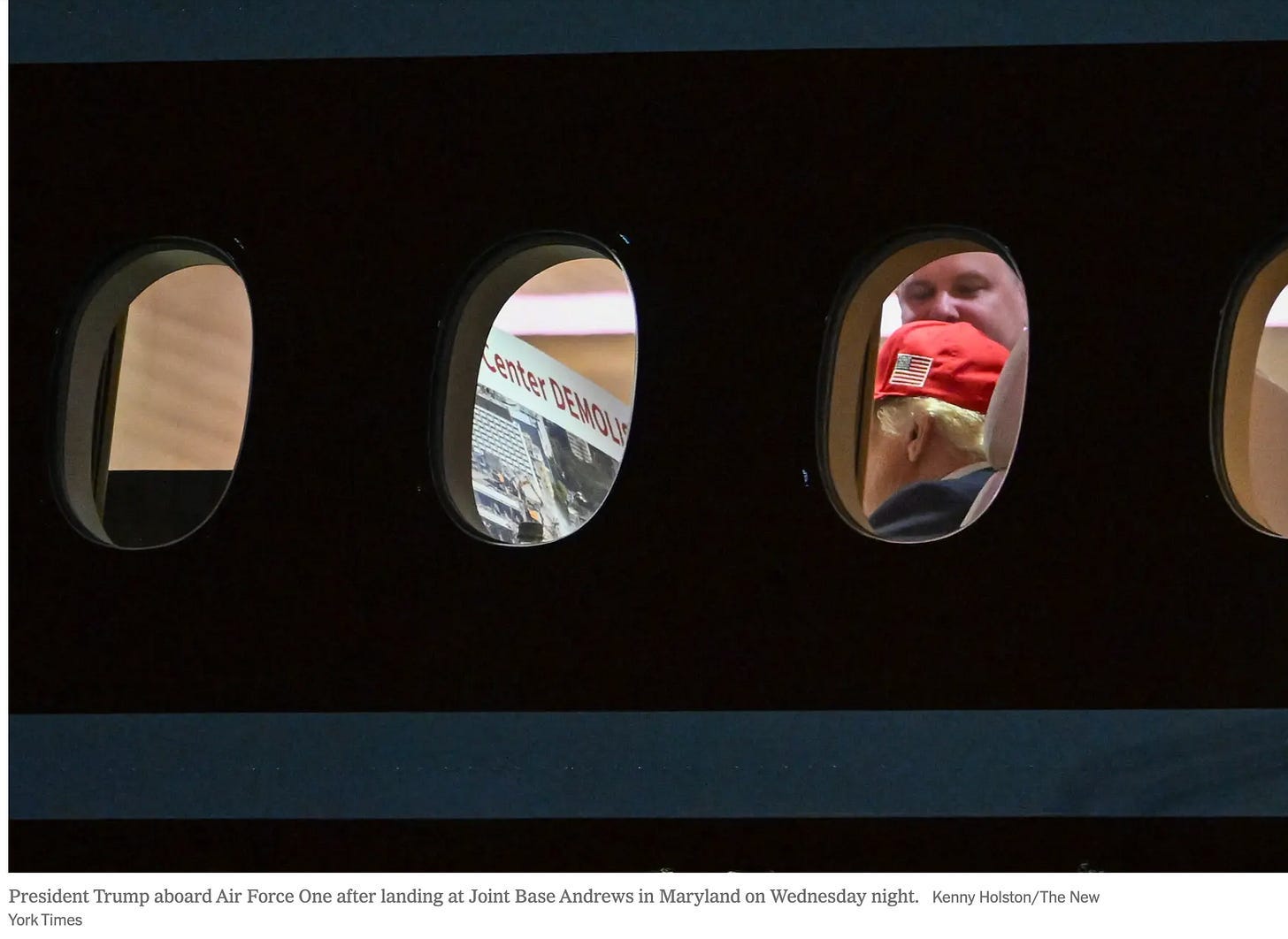
In response to images of the potential demolition of the Kennedy Center, a crowd stood around it. This is what it is like to live under a personalist form of government. We can no longer expect that there are adults in the room, that laws and norms hold, that wiser heads will prevail. If the President decides to bulldoze a beloved cultural institution, as he did to the East Wing of the White House, who will stop him, except ourselves?
Even as Trump demanded the prosecution of vandals for the self-inflicted damage to the Reflecting Pool (still empty, by the way), it is clear that the vandals are coming from inside the White House.
What the Reflecting Pool Actually Reflects

Different types of government failures grab our imagination: cover-ups, tragedies, personal moral failings, and corruption all lend themselves to narratives that humans naturally relate to.
The Kennedy Center is an important story in its own right. But, like the Reflecting Pool, it is also symbolic of the incompetence and corruption of the Trump regime. Trump is a real estate guy who cannot manage real estate, so we should have even less reason to believe he can manage the bigger challenges of governing.
His personalist model is at odds with educational, military, scientific, or health institutions that are ultimately nonpartisan in much of their operation. Of course, Presidents have always had an influence over these institutions. But Trump demands something different, which is personal ownership of public institutions. Our government should be no different than a Trump hotel.
To make this point more concrete, let me give another example, seemingly unrelated. Trump appears to have sided with his budget chief Russell Vought to centralize research funding approvals out of the NIH and into a special White House committee. This reporting is important for a couple of reasons. It shows Trump is directly involved in these decisions, and that Trump’s motivations are personalistic: he wants a mechanism by which he can punish Harvard, and other institutions that he dislikes. As with the Kennedy Center, a handful of political allies will determine the fate of the institution.
The effort to control NIH more and more tightly again underlines the point that the Trump administration cannot conceive of any institution as nonpartisan. NIH, today, is more politicized than it has ever been. But it is not enough if it does not give the President a “Fuck Harvard” button.
Congress, even under Republicans, does not like this overt politicization of science. It blocked, at least temporarily, a previous Vought plan to have OMB appointees make decisions on scientific funding.
The Creep of Politicization

The White House proposed new policies governing the federal funding of American science. You’ve already heard about the funding cuts, de facto impoundments of funds, funding freezes to disfavored universities, and cancelation of grants that include the long list of the
Given the conflict between Congress and the executive branch, this fight will likely go to the courts. And at least some members of the Supreme Court will say “yes, this is what the founders wanted. They wanted the President to have the power to use his public office to punish his political enemies. That is what the revolution was for.” Ok, they won’t use those words, but will instead go along with a polite political fiction that Trump’s desire for vengeance is not what is driving these actions.
Vought has his own goals which are a) to reduce scientific funding generally, and b) to cut it especially sharply for universities. In this, he is in a fight with Dr. Jay Bhattacharya, the head of NIH, who has told Congress he will spend the money allocated to the agency. Vought argues that even now, even after the AI-assisted purges of research, and thousands of cancelled grants, wokeness still infects research, and that only he can rescue the integrity of science.
Vought would sit on his proposed committee, which would allow a single member to veto any spending on health research. And so, in effect, Russ Vought will give himself a line-item veto button that Congress never granted over $48 billion in NIH spending. The person that Trump compared to the Grim Reaper will determine where our public health research dollars go.

The economic analyst Catherine Rampell noted the historical parallels in the politicization of science:
It really is striking how many authoritarian states have ended up in this exact same place, where the leader seizes control of scientific inquiry. Lysenkoism in the Soviet Union, Aryan Physics in the Third Reich, Great Leap Forward (also related to Lysenko) in China. Not an exaggeration to say when authoritarian thugs distort scientific research toward their own petty or prejudiced tastes, economies suffer, national security is compromised, people die. Exact proportion of each of those consequences varies from one authoritarian state to another, but all happen
This gets us to the practical problem of delegation and governance. It is impossible for a small set of busy political actors — whether it be Congress or the White House — to know what are good scientific bets. Every government has to delegate decision power on such issues, and if they are smart they delegate to experts rather than political hacks who will corrupt the science.
But Trump/Vought want to be able to determine the final decisions, to reduce spending (contrary to the law), and pursue ideological control and petty revenge missions. That is what “the president’s priorities” will be a euphemism for in whatever executive order will emerge. Despite conservative arguments that the legislature can reclaim its power with more detailed legislation, Congress cannot simply write more detailed legislation that replicates the NIH.
My University of Michigan colleague, and former General Counsel of both HHS and OMB, Sam Bagenstos told Jonathan Cohn that changes pushed by Vought would run contrary to the statutory provisions over how Congress has delegated power over NIH:
In our constitutional system, those decisions are vested in Congress because Congress has the power of the purse. And we made a democratic decision through Congress—established in the 1940s, but then reaffirmed many times through the years—that once these broad priorities are set by Congress, the best way of figuring out where specific streams of money go is to very significantly rely on scientific communities to advise on that question.
But Congress can’t delegate effectively when the executive branch, with support from the courts, ignores its wishes about conditions of delegation. Trump and Vought are trying to abuse their office and undermine science in obvious ways that Congress does not want and no previous President attempted because they think there is a good chance SCOTUS will let them. And they think that because they are in the same club.
Here is another piece of art that explains our current moment. This painting of Harlan Crow hosting Clarence Thomas and Leonard Leo (who helped promote unitary executive theory via the Federalist Society that shaped conservative judicial thinking) features Mark Paoletta (center), the current OMB General Counsel, who is devising such work arounds. Paoletta is close friends with Thomas, having assisted during his confirmation hearings, written a book about him and served as a lawyer for his wife.

There will be absolutely a few votes for whatever Paoletta comes up with, because there are a few votes for any expansion of Trump’s power. For example, the DOJ is already using the Slaughter decision that allows Trump to remove the heads of independent agencies to justify removing lower-level civil servants. To be more specific: Trump fired DOJ prosecutor Maurene Comey because she is the daughter of James Comey. And in court, he is now arguing that the Slaughter decision gives him the right to do so. There is no real argument that this is about government performance, or responding to the needs of the public, merely that the President has King-like powers to punish those he dislikes.
Another example: Trump has declared his proposed Arch in Washington DC has a national security aspect, with snipers and drones and lasers! (Ok, he did not mention lasers, but since we are making stuff up, why not? Why not some sharks with lasers?)

No one believes this, of course. Having a military installation that is also a tourist destination in the middle of a crowded city is a recipe for disaster, as well as extraordinary delay for the commuters who must encounter it. But the point is to create a legal pretext for the Supreme Court to let Trump do what he wants with Washington DC. The national security rationale for the creation of the White House ballroom provides a precedent. But to work, it also requires the judges not to…uh…judge the plausibility of Trump’s claims.
And time and again, the Republican majority on SCOTUS has shown they would prefer to defer than engage in the hard work of judgment. In this, they have co-produced Trump’s personalist regime. They deserve their own gold-leaf portraits at the empty Kennedy Center. We deserve something better.
Terrific article Don, but incredibly sad. This is indeed where bad taste and bad government become one. Given who is making these decisions, it's no wonder. As you said, "the rot begins at the top."
Too true. All of it.