A new proposed rule from the Trump administration would dramatically change how the 2030 Census would operate. The biggest changes would be to exclude non-citizens from the count used to calculate congressional representation, and to remove questions about race and ethnicity.
I am a historian of the Census and believe that the changes would take a sledgehammer to another element of the American state with a radical proposal to alter the methods and rules governing the decennial population count of the American population.
The actual count isn’t scheduled until April 1, 2030, but the recent spate of Federal Register Notices, Department Administrative Orders, political appointments in the Census Bureau, and instructions for staff to refrain from communicating with the public, amount to one clear lesson: the venerable traditions that have guided how Americans “stand up and be counted” each decade are intended to go down the memory hole.
So, not surprisingly, some people are upset. Data users, advocates for evidence-based policy making, the media, research shops, state and local government officials have collectively engaged to stop this train before it damages another core institution of the American state. They have to move quickly because the administration is following its ‘move fast and break things’ strategy in the hope of creating facts on the ground that can’t easily be undone before April 1 2030.
Notably missing, at the moment, is Congress. Article 1 of the Constitution gives the responsibility for defining how to administer the census to Congress, “in such manner as they shall by law direct.” That provision derives from the fact that the Constitution mandates that seats in the House of Representatives and votes in the Electoral College be allocated among the states “according to their respective numbers.”
So what’s the administration plan?
1. Write new “residence rules” for the census and add a question on “citizenship” to the census.
2. Drop questions on “race, ethnicity or sexual orientation” in the census.
There are other proposals, but let’s start with these.
New “residence rules”
The census counts people at their ‘usual residence,’ their address on April 1 of the census year 0 [zero]. The Census Bureau calls it “the largest nonmilitary mobilization of the American public.”
These days, the Census Bureau does that by creating a “master address file” of all the residential addresses in the country, geocoded to a map, called TIGER [Topologically Integrated Geographic Encoding and Referencing]. They used to do it by hiring 600,000 or more temporary employees and giving them a small map and telling them to walk around and knock on every housing unit and fill out a big form for who lived there. Now, most addresses get a postcard with a code to go to an online form which one person per address fills out with information about everyone who lives at the address. It’s “ten questions” that takes “ten minutes” according to the Census Bureau. Hit send and that’s it for the decade. The practice is to count everyone, as the Census Bureau says, “once, only once, and in the right place.”
However, if you change the rules on “usual residence,” that decision can affect which addresses get the postcard to respond, and then which responses get counted.
The administration is proposing that only citizens and people with “lawful permanent residence status” should be counted for congressional apportionment.
We’ll get to why they want to do that in a minute.
First, though, a conundrum. The Census Bureau doesn’t know much of anything about the people who live at an address when they send the postcards. They don’t even know if the address is “occupied” or “vacant.” And they don’t know if any person living at the address is a “citizen” or a “lawful permanent resident.”
So the administration is also proposing to add a question on “citizenship” to the census so that they can find out who should not be counted. There’s never been such a question asked of the entire American population, for any reason, on the 24 decennial censuses taken since 1790. During the first Trump administration, the Secretary of Commerce proposed to do so, but the courts ruled against adding it in 2019. So, there isn’t a precedent that to demonstrate such a question would elicit the information they’re trying to acquire.
Interestingly, the federal register notice discusses that problem, and adds another new wrinkle to the question of how to take the census. “The Census Bureau is considering,” they acknowledge, “how best to distinguish between foreign citizens in the United States who are counted for apportionment and those who are not counted for apportionment.” They suggest that records from other federal agencies, for example, Homeland Security, the Department of War, the Department of Health and Human Services, could work, through a “data linkage infrastructure” that would match a response to the census to another data system that did have information on alien “legal status.”
The federal register notice does not provide further analysis of whether such a counting methodology would be robust enough to use by 2030, whether it would be accurate or whether it would withstand judicial scrutiny.
The next question is why the administration is proposing such a redefinition of the residence rules for the census given that there are lots of technical problems of survey design and management that would have to be solved before 2030 implementation.
Their answer is conceptual, not operational. The administration is effectively saying, “we’ve been doing it wrong for 250 years,” so we need to fix it. We shouldn’t be counting “people,” “inhabitants,” “residents.” The federal register notice cites 18th century legal sources, which they claim, support a strategy for counting “citizens,” and those people who have “durable permission from the sovereign to settle within the United States.” The only non-citizens who should be counted in the census for apportionment – there’s no further information about the impact of such a practice for other uses of census data – are those to whom the “sovereign” has granted “lawful permanent resident status.”
Questions on race, ethnicity and sexual orientation
The administration is proposing to drop questions on “race, ethnicity or sexual orientation” in the census. These are somewhat different proposals. There has never been a question on “sexual orientation” on the census. So what problem is this proposed change solving? There has been a question on “sex” since 1790.
The restriction on questions on residents’ race or ethnicity is based on a claim that the Constitution is “colorblind”:
The Census Bureau is considering these two additions [to the Code of Federal Regulations] to better prioritize and fulfill its Constitutional mandate to count for apportionment the “whole number of persons in each State” based on the concept of “usual residence”—a process that factors in an element of allegiance but otherwise should be colorblind and should not be distorted in any way by questions about immaterial personal characteristics, such as race.
In fact, the mandate for questions on “race” was in the Constitution, in two separate contexts. Contrary to what the Trump administration claims, questions related to race were rooted in practices of indigenous conquest and the history of slavery as a labor system in the U.S.
As such, the data systems of the American administrative state have always documented the distinctions of race (see Figure 1, from KFF).
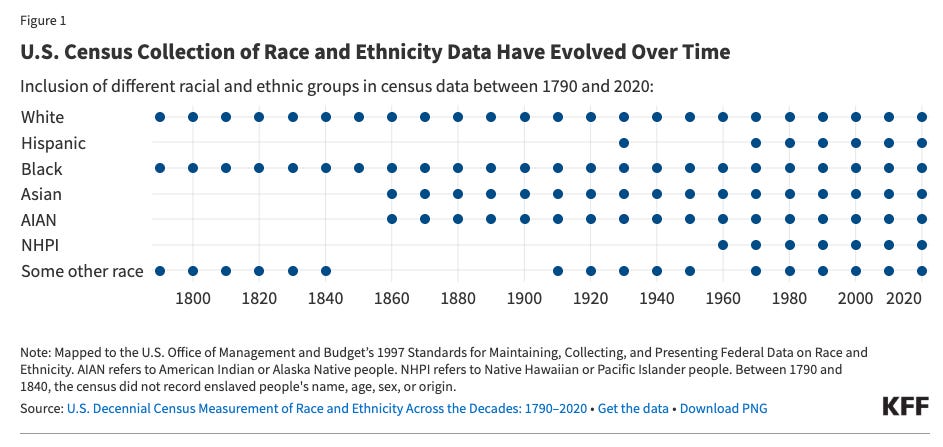
The first was the language in the Constitution to separate “free persons” from “other persons,” the euphemism used in Article 1 for enslaved persons. The first census statute translated “free persons” to “whites” and “other free persons” for the actual census form, and by the 1820 census Congress had added age and sex categories to distinguish the “free colored” population and the enslaved population (presumed to be “colored”).
The second was the mandate to exclude “Indians not taxed” from the “actual enumeration,” such that American population history has had to reconstruct the demography of the indigenous population from non census sources from 1790 to 1890, when the Census Office did begin to conduct censuses of the “Indian population.”
What happens if the Trump administration succeeds?
The effect of the administration proposals, if implemented, would be dramatic. The nation would face major loss in demographic detail on the American population. It is by no means assured that a census with a citizenship question and without questions on race and ethnicity would be accurate, fair, and useful. It would have ripple effects on the downstream uses of population data for the measurement of key economic indicators, such as unemployment, health and family structure, and impair overall census quality, including the measurement of gross and net undercount and overcount.
It would be blurring the mirror that Americans have relied on to know their society, to say that only some people should “stand up and be counted,” and participate in democratic governance. For example, the tabulations from the decennial census, with their breakdowns by geography, race, ethnicity, age, sex, and household structure and housing status, have become workhorse datasets for the analysis of patterns of fertility, mortality, health, or labor availability.
The operational planning phase of the census is a decade or more process. The first operational plan for 2030 was issued in 2025, along with a testing schedule of innovations. The administration modified the testing schedule, cut the scope of the tests, and proposed to use postal workers as field staff for the census, a method the bureau has tested and rejected in the past. The Department of Commerce Inspector General Office is now reporting a “Management Alert,” on “Oversight Issues Observed During the 2026 Census Test.”
Abrupt changes to long established data infrastructure, as proposed in the federal register notice, will surely damage what we can know about the health of the body politic.
To return to some history, in 1776, before the first census, the Continental Congress declared that “all men are created equal,” even as they recognized that potentially dangerous aspirational claims that would engender. In 1776, Abigail Adams pointed out in private correspondence with her husband John how she saw that claim, and urged Congress to “Remember the Ladies.” The Seneca Falls Declaration [1848] said it out loud, proclaiming that “all men and women are created equal.” Abolishing slavery, as Frederick Douglass reminded his readers, would abolish the Three Fifths Compromise and would also enhance the number of seats held by the “slave states.” The Thirteenth Amendment [1865] made that a reality as Congress considered how to admit the states of the former Confederacy to the union. The Fourteenth Amendment [1868] and the Fifteenth Amendment [1870] to the Constitution were the result, particularly Section 2 of the Fourteenth.
Over much of the course of the nation’s history, the “data” in the census, particularly the “race” and “ethnic” variables, have served as justifications to discriminate. These data have also served to document discrimination so it could be remedied in civil rights law. The nation has counted to discriminate, and has counted to liberate. Americans came to recognize that they needed to count fairly and accurately. How to do that has been the subject of controversy and democratic decision making ever since the founding.
The comment period for the federal register notice is open through November 2, 2026. You don’t have to be a census junkie like me to put in your 2 cents. Anyone can comment: link here. Democracy is for everyone, at least for now.
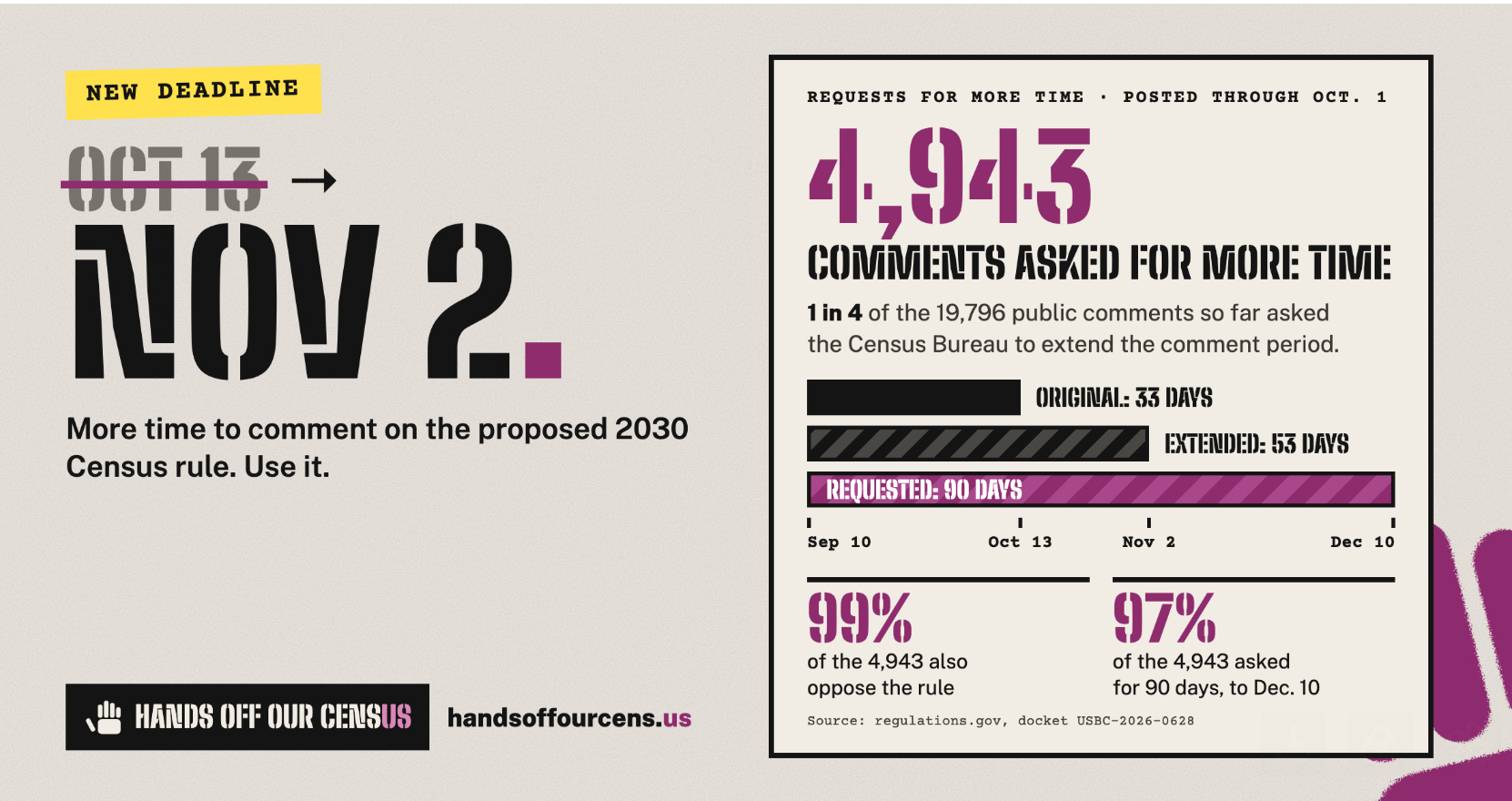
Additional resource: Hands Off Our Census
Margo Anderson has published two editions of a general history of the American population census, the latest in 2015, The American Census: A Social History. With Stephen E. Fienberg, she authored Who Counts? The Politics of Census-Taking in Contemporary America, and most recently, coauthored with Willia Seltzer, The Use and Misuse of the United States Census: The Role of Data in the Incarceration of Japanese Americans during World War II. Find her on BlueSky
More from Can We Still Govern?
DOGE vs. Civic Tech

DOGE wielded extraordinary power during the first months of the Trump administration. It was more important than any Cabinet official. The fact it has been completely memory-holed by this administration says much about its purpose and impact, and the politics of non-accountability under Trump.
The art and science we deserve?

The Kennedy Center is an arts center. This is the kind of art you can enjoy there now.
Unions Against Voughtism

In the United States today, it’s hard to know whether the food you buy will land you in the hospital. There are currently dozens of active recalls—precisely the sort of outcome foretold by current and former federal government workers who warned against President Donald Trump’s shredding of our food safety net. It’s one example of where the public would…
I am not persuaded that removing race/ethnicity/sex fields is a bad thing. Haven't we learned that we do NOT in fact want a government database of people that the government can then use to discriminate? Do you really have no other way to conduct academic research than large-scale government-run surveillance? Going forward we should be collecting and storing as little information as humanly possible, as responsible government stewards.
...which is why it's important to put comments in the Federal Register Notice....