Private Chains, Public Harm
How Supply Networks Fuel ICE Operations

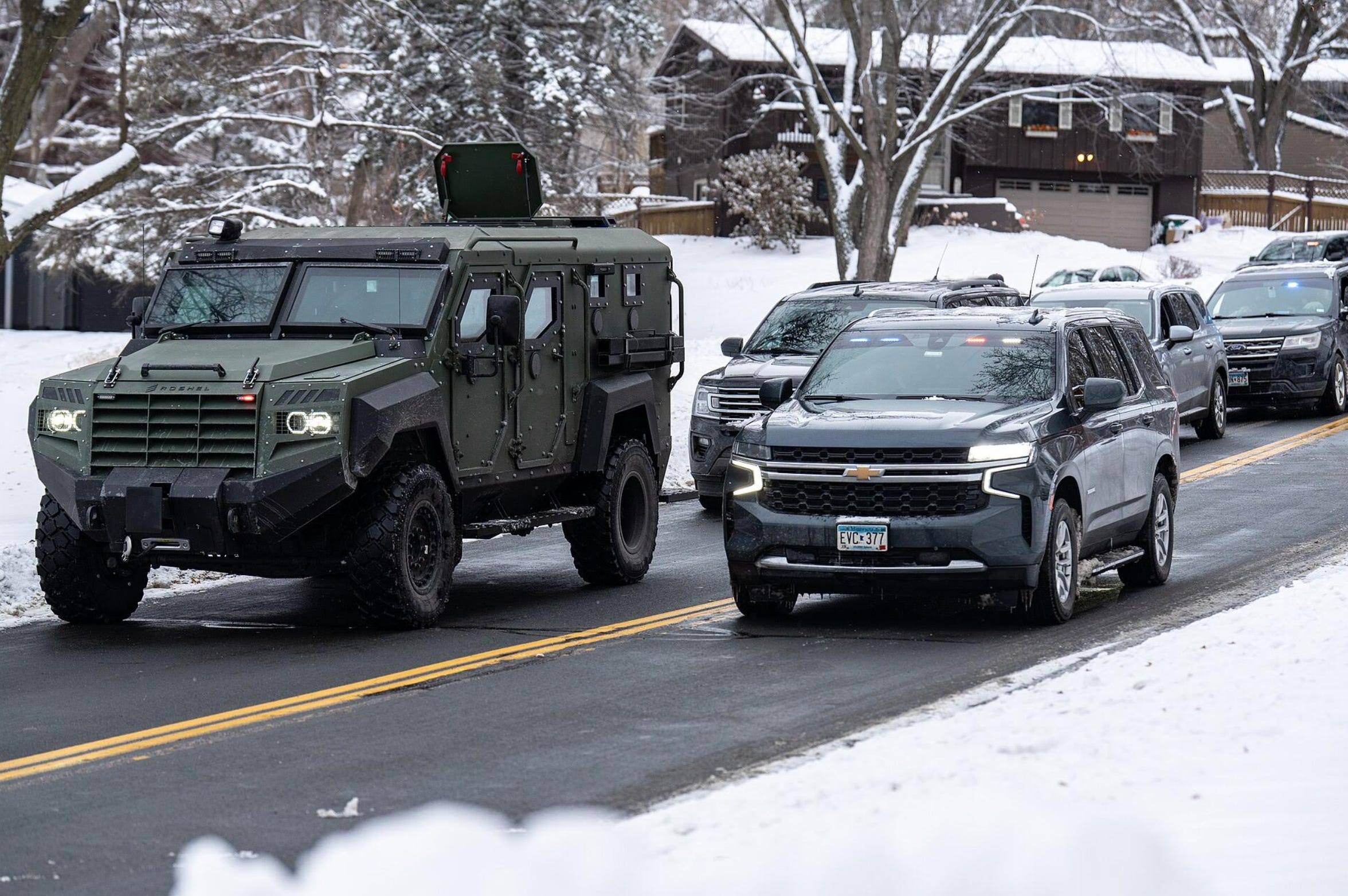
In November 2025, U.S. Immigration and Customs Enforcement (ICE) placed a rush order for 20 bulletproof personnel carriers from a Canadian manufacturer, Roshel, to deploy in ongoing operations. What appeared to be a routine, quiet purchase soon drew attention to an otherwise opaque set of relationships, revealing how ICE’s coercive capacity, its ability to compel obedience, depends on a global network of contractors and foreign suppliers that often remain outside routine public scrutiny because they are embedded in private market transactions.
ICE, the largest investigative division of the Department of Homeland Security (DHS), has grown from a $6 billion budget in 2015 to $85 billion today, making it one of the most powerful arms of the American state.
Well-funded and fiercely operational, its agents appear suddenly, act aggressively, and vanish just as quickly, such as in “Operation Catch of the Day” in Maine, which only lasted a week yet resulted in roughly 200 detainees and rattled residents in the border towns of Calais, Maine, and St. Stephen, New Brunswick.
We often focus on acute instances of extreme violence, arrest numbers, detention capacity, and deportation totals, and for good reason. Behind these metrics are everyday people whose families, workplaces, and communities are directly shaped by these operations. The picture that emerges is one of a contentious yet incredibly unified, insular, and well-resourced system.
What is rarely discussed is the supply chain that makes this system possible.
ICE exercises power through centralized command and the institutional legitimacy the DHS grants it, whether that’s carrying out operations or using repressive tactics in response protests in cities like Minneapolis. Yet, its operational capacity is assembled through a patchwork of contracts, vendors, procurement rules, and information systems, much of which is mediated by cross-border supply chains that produce the appearance of a fully domestic, self-contained enforcement apparatus.
Outsourcing Operations
Much of the infrastructure that enables these operations, such as armoured vehicles to transport agents, leased aircraft used for deportations, and surveillance technology developed to track citizens and non-citizens alike, is in fact built on outsourced contracts. In other words, while ICE is formally a domestic, government-run agency, its operations rely on a broader network of private firms, both domestic and foreign. This analysis focuses specifically on the transnational actors that make these operations possible.
In practice, ICE enforcement relies on:
outsourced detention facilities,
private transportation contractors,
commercial data brokers,
biometric technology vendors,
analytics platforms,
and procurement pipelines that span multiple countries.
Each component is governed by different rules and oversight regimes. Authority is fragmented across agencies, firms, and jurisdictions. Yet the system produces a singular experience for the people subjected to it: coercive capacity that feels utterly total and unassailable.
Foreign Firms In The Supply Chain
Canada
When President Trump mused about Canada becoming the “51st state,” his provocative rhetoric quickly began to fuel anxiety about Canadian sovereignty. Most Canadians now see the United States as not just a trading partner but a potential threat to their nation’s autonomy. Given President Trump’s consistent animosity toward Canada, and his assertion that the U.S. doesn’t need Canadian products, it’s curious that any company based in Canada plays any role in ICE operations.
On December 1st 2025, The Independent reported that a multi-million dollar rush order for “20 bulletproof personnel carriers” to be used by ICE was being made with a Canadian manufacturer, Roshel, headquartered in Brampton, Ontario with plants in both Ontario and Michigan. According to a document released by ICE’s Office of Acquisition Management, they explain the logic for choosing Roshel was that it was the only company that had vehicles that met ICE’s specifications available on short notice.
Days after The Independent made this information public, ICE released an email statement defending their decision to purchase from a Canadian manufacturer, insisting that Roshel fell under “Buy American” provisions because “production of the […] emergency response vehicle originates in the United States.”
It’s not just Roshel.
A U.S. subsidiary of the Canadian private security firm GardaWorld, headquartered in Montreal, also has commercial ties to ICE, including staffing facilities like the South Florida Detention Center, nicknamed “Alligator Alcatraz.” A facility that has reportedly operated “outside the normal channels for immigration detention, without regard for multiple limits and safeguards in federal law,” allegedly resulting in prolonged detentions without removal charges, untracked detainees, and abysmal physical conditions.
France
Like Canada, France has also recently faced a series of complex hurdles in its relationship with the U.S. Amid these pressures, France has been drawn into a domestic controversy over the French IT giant Capgemini’s role in developing data tools for ICE operations.
Capgemini’s U.S. subsidiary held a contract with ICE to provide “skip tracing” services. These services involve data-driven tools that track individuals’ whereabouts, including verification of home and work addresses. According to the BBC:
“Capgemini Government Solutions is set to be paid more than $4.8m (£3.5m) for its work tracing people for ICE, which is due to continue until 15 March, US government listings show. It is one of 13 contracts the subsidiary holds with ICE.”
Earlier this year, when Capgemini’s ties to ICE first surfaced, the company claimed they were not aware of the contracts. However, investigative reporting from French news outlet Les Jours quickly undermined that claim, uncovering evidence that the relationship between Capgemini and ICE went back almost twenty years. Additionally, records on USAspending.gov indicate that 65% of the contracts Capgemini received from the U.S. government were with ICE.
Following media scrutiny over the use of its technology in ICE operations, the company published a statement stating it was going to sell its U.S. subsidiary.
Ireland
While the Canadian and French examples illustrate more straightforward cases of ICE contracts being awarded to companies headquartered outside the U.S., sometimes the nodes within a supply network can be a bit more difficult to trace.
Approximately one quarter of the world’s commercial aircraft are owned by companies based in Ireland, establishing the country as a central hub for aircraft leasing. Ireland’s attractiveness as a base for aviation finance stems from its competitive corporate tax regime which offers specialized incentives tailored to the aviation sector, including exemptions on specific income streams and capital gains related to aircraft leasing. In addition to this, its legal system provides robust protections, such as fully implementing The Capetown Convention, which safeguards lessors’ rights.
Investigative reporting by The Journal has identified major Irish leasing firms, including Dublin-based Genesis and AerCap, as well as other companies with offices in Ireland, that lease aircraft to U.S. charter airlines such as GlobalX and Avelo, carriers contracted by U.S. Immigration and Customs Enforcement (ICE) to operate deportation flights.
While there’s no evidence that Irish firms explicitly endorse U.S. immigration policies, their role as lessors means planes they own or manage may be used to transport people under controversial deportation programs.
Fragmentation Enables ICE Enforcement
Together, the cases of Canada, France, and Ireland, illustrate how domestic U.S. enforcement relies on transnational infrastructures, since even U.S. subsidiaries are nodes in a larger transnational system. Whether through manufacturing, data services, or aircraft leasing, ICE’s capacity is assembled across borders, highlighting how state power is materially produced through global supply chains.
In the end, the result is not a unitary apparatus but a distributed logistical system that projects state power while concealing its reliance on external actors.
This logistical architecture matters because it fragments accountability. When enforcement is produced through vendors and cross-border procurement, responsibility is spread across contracts, jurisdictions, and regulatory regimes. Foreign firms can appear as neutral suppliers or technical partners rather than political actors. Enforcement persists both because it is tightly governed and because it is carefully assembled through a marriage of domestic political aims and foreign economic interests.
The Artificial Siloing of Markets and Politics
Political relationships between countries and market relationships between firms are often treated as separate spheres but, in practice, they are deeply intertwined. Foreign firms operating in global markets have strong economic incentives to follow through on contracts, even when their work intersects with sensitive political objectives. Governments, by contrast, may lack the same incentives: they may disapprove of certain activities but have limited authority to intervene, outside of formal legal or regulatory mechanisms. This divergence means that private actors can continue operations that their governments might prefer to constrain, effectively creating a gap between state intent and on-the-ground activity.
In essence, the global supply chain sustaining ICE operations is governed partially by national oversight and partially by market logic.
This dynamic, in turn, may expose the United States’ own vulnerabilities.
By relying on foreign firms to implement enforcement operations, the U.S. gains reach and flexibility, but it also risks becoming dependent on these actors. Implementing controversial policies through foreign companies while simultaneously agitating their home governments, through economic pressure or threats of military intervention, can expose these dependencies, as both publics and governments may push back in ways that disrupt the supply chain.
Although many of these firms operate through U.S. subsidiaries, their parent companies face different forms of pressure at home. Even though economic incentives can be strong, public scrutiny can trigger rapid responses, such as Capgemini, announcing the sale of its U.S. subsidiary. Other firms have also reportedly canceled deals in response to reputational risk.
Government pressure, by contrast, is slower and formal. For instance, Canadian Member of Parliament Heather McPherson recently published a letter urging the federal government to impose sanctions, export bans, and cancel subsidies to constrain Canadian companies’ ability to contract with ICE.

Even when operations appear domestic, corporate behaviour is influenced by both international relations and transnational economic pressures, reinforcing the distributed and contingent nature of ICE’s logistical capacity. Recognizing ICE’s dependence on foreign-owned firms reveals potential points of structural leverage that both foreign governments and civil society may have to influence enforcement practices within the U.S.
By pressuring companies, scrutinizing contracts, and demanding transparency, both publics and policymakers can materially constrain the logistical structure of U.S. enforcement operations. In this sense, the globalization of enforcement does not simply expand state power, it also redistributes the sites where that power can be contested.
 | A guest post by
|
This is a “dark network” that needed to be exposed. Thank you!!
Great essay. I must admit that I hadn't thought about the supply chain supporting ICE, especially the global implications. Thank you for this important piece of information.