
Behold: one of my favorite explanatory images about American government:

The image, as you might have guessed, is from The Onion. The joke (for me at least) is the idea that there would be celebratory media coverage of routine effective government performance.
So why would such a headline not exist in actual media coverage of government? A glib response is that we only notice government when things go wrong. Here are more sophisticated explanations:
Negativity bias: The media covers failure much more than it covers success. Loss aversion means that humans are more emotionally aroused by stories of loss rather than gain, failure rather than success, scandal rather than honest competence. In other words, the media focuses on failure because that is what, as consumers, we click on.
Independence: Media don’t want to be seen as the lapdog of politicians, so tend not to uncritically accept good news stories. I’m not going to publish your press release!
A bias toward theater: People like stories. Stories that involve colorful characters, human stakes and theatrical tropes, such as deception and conflict, are more compelling. And so media coverage of government reflects such stories, and down-weights other factors that are harder to humanize, such as administrative systems, or structural factors, even if those these factors are often important, as they are when it comes to managing government. Really great writers manage to tell stories about government that incorporate structure while using relatable characters, explaining the stakes, and detailing emotionally arousing conflicts. But sometimes, reporters on a deadline simply do not cover stories that lack the aspects of theater, and focus on the opportunities that do.
Voters generally have a hard time understanding cause and effect when it comes to changes in public sector performance. It is complicated! And polarization and media bubbles make it less likely they will give fair credit to the politicians who are trying to make things better. Things may have to get very bad for people to acknowledge that their co-partisans are doing poorly (though we may be seeing this now with Trump).
And so, media coverage plays a critical role in educating the public about whether their government is working well or not. This is especially true for traditional media who seek to be broadly non-partisan.
But think about the incentive structure for politicians. If media attention goes to failures rather than successes, the incentives are to avoid failures: don’t rock the boat, don’t take risks, don’t try something with an uncertain payoff. Avoid blame at all costs.
This makes investing their time in the details of government a relatively poor bet for politicians. The details are too wonky, administrative processes are difficult to explain, the time required to master the topic is too great, the time required to see results is too long, and the potential for failure is high. All of this makes a political payoff is too unlikely.
Mamdani and the political capital of implementation
I’ve been thinking about this challenge in the context of Zohran Mamdani’s mayorship. Mamdani is doing something interesting, which is investing a huge amount of his political capital into the nuts and bolts of governing. He has lots of videos about filling potholes, the value of public servants, fixing playgrounds, infrastructure renewal, encouraging citizens to use the 311 number to report service problems.
Some of this has broken through to the public, such as stories of New Yorkers tagging Mamdani on social media about potholes or other quality of life issues, and then finding their complaints addressed.
Mamdani’s vision could be seen as a callback to sewer socialism — associated with early 20th century Milwaukee Mayors who focused on public utilities — or if you are of a more conservative bent, the fixing broken windows theory of James Q. Wilson, which emphasized the value of visible order as a pillar to strong communities (but without the stop-and-frisk policing that Wilson’s theories inspired).
Mamdani is very focused on implementation. And honestly, I am a little hopeful that if he is successful, other high profile elected officials will be willing to spend a little less of their time dreaming up new policies, and a little more ensuring that policy promises already made are fulfilled. He is also exceptionally skilled at the short form videos that dominate social media, and by focusing on implementation offers a useful form of civic education that reminds people that government services exist, and need attention if they are to function.
But Mamdani’s strategy depends upon people hearing about implementation. And here, he and other politicians willing to devote time to public administration, face a dilemma. What if the media simply does not care? What if they won’t cover what you are doing, or give it a tiny amount of attention relative to more negative stories? What do you do then?
This has been bothering me for a while. I spoke to a reporter in an outlet that covers government and tech who shared their frustrations about trying to cover Mamdani’s implementation work, because the editor they pitched to wanted the story to feature more politics, more conflict, more theater. Good government, by itself, does not seem to be terribly interesting.
The story the Times told about Mamdani
Which brings me to a recent story about Mamdani in the New York Times by two reporters whose beat is New York City government and the Mamdani administration.1 Here is the headline for the story:
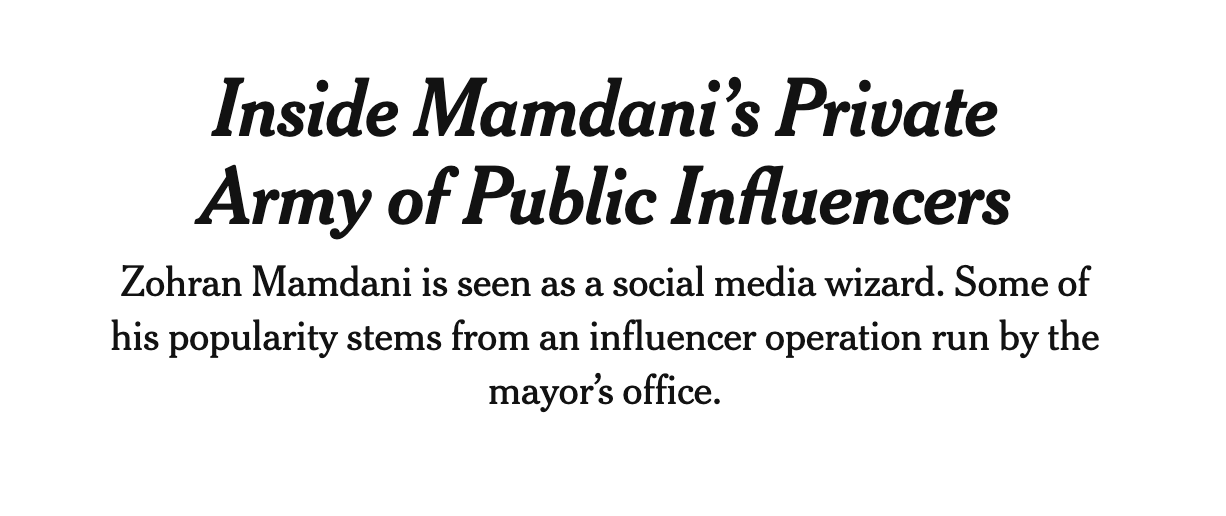
The opening paragraphs detailed that when Mamdani cancelled $9 million dollars in contracts with the consulting firm McKinsey, many online influencers cheered.
But some of it was actually part of a campaign orchestrated by City Hall to use social media influencers to boost the image of the mayor and his young administration’s policies.
Mr. Mamdani is a master of new media, and his rise to power has been driven largely by his ease in front of a camera and his ability to harness the seeming informality of social media to connect with broad constituencies.
But as mayor, he has also been able to use taxpayer funds to create a sprawling network of hundreds of friendly influencers to boost his priorities, provide positive depictions of his administration and enhance his popularity.
This sounds bad for Mamdani, but a good story! There is the implication of deception, a cover-up, and misuse of government resources!
But after that, the story falls pretty flat. While the headline suggests that “Some of his popularity stems from an influencer operation” the “some” is doing a lot of work. The counterpoint — that the substance of the stuff he is trying to communicate is popular and worth discussing — is not really considered.
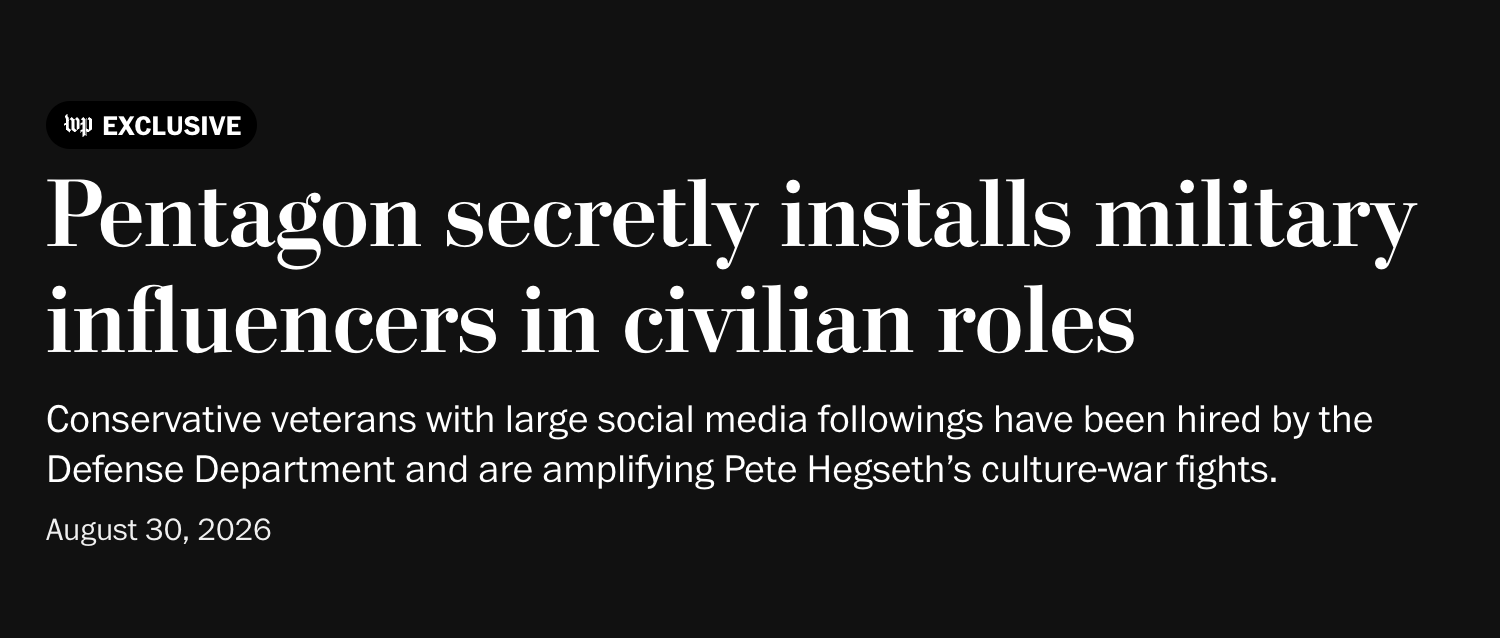
Mamdani is using taxpayer resources? Again, that sounds bad. It is a problem that politicians pay influencers who do not disclose it as the Times has covered. It is a real problem if the government hires influencers at all as they engage in propaganda. The Pentagon has been doing this, as the Washington Post revealed. By comparison the Times Mamdani story feels more like a damp squib of insinuation that never delivers the type of actual scandal we see in the Post story. The influencers at the heart of the Pentagon story even claimed that the Times passed on it, which would be extraordinary if true, especially in the context of their piece about Mamdani.
It is not until paragraph 20 that the Times reporters clarify that the Mayor’s office does not actually pay the influencers. The sheer distance between this very crucial fact, and the opening paragraphs and headline is problematic. Later, the piece notes that the city’s Campaign Finance Board paid a private company who contracted with 18 influencers to boost turnout. Why mention the fact that a part of the government not controlled by Mamdani publicly disclosed that they paid influencers before he was Mayor for a non-partisan purpose? The article also notes that some City agencies have paid influencers to promote policy agendas, but do not connect that back to the Mayor’s office.
What about the taxpayer funds? The Mamdani administration is paying an employee to lead social media outreach, in much the same way that comms offices have always paid staffers to do media outreach. The influencers are boosting Mamdani’s work because they agree with it, or, as the reporters suggest, because it boosts its social media profile and potentially makes them money. Is this an ethical problem? Put it this way: the possibility that a social media influencer might make money because they can make tidbits from the government comms office go viral is does not seem meaningfully different from New York Times reporters being able to land book deals based on information provided to them from White House officials.
The most serious allegation is that the administration was using Signal, a private messaging app, to communicate, which a pro-transparency advocate quoted in the story says violates transparency laws. I am pretty sure that is inaccurate: it is the deletion of messages not the form of messaging that violates transparency laws, and the Mamdani administration committed to ensuring that such messages would not be deleted in the future, though they may have been in the past, which would be a real problem.
The insinuation of wrongdoing gives the article its purpose, but the actual evidence of wrongdoing is thin. In short, the key objection of the article is that the Mamdani administration has professional comms people sharing press releases and talking points before public announcements…which is standard practice for how government has treated legacy media. The key difference is that they are now doing it with new media. And the Mamdani administration have not always followed official government transparency processes to do so. But reporters have been willing to overlook this as long as they, and not influencers, are the beneficiary of a heads-up on a story or a leak from a friendly government insider.
The story the Times (and others) are not telling about Mamdani
Let me offer one theory for why the Mamdani administration is working with social media. It is not very complicated: non-traditional media is a more effective way of getting out political communication about substantive government action than traditional media. They are not professional reporters, to be sure, but as a result they are not as beholden to the norms and biases that makes it harder to get positive stories out.
Let’s go back to the primary example the story gave, because I think it would have been useful if the reporters grappled with it a bit more. The Mamdani administration cut $9 million in McKinsey contracts as small part of a relatively impressive effort to balance the budget. So how did the New York Times cover this story? I found two mentions of it in their coverage, both of which were passing references in larger stories:
From May 1, in a story titled “What We Know About New York’s Proposed Tax Increases": “Mr. Mamdani has already begun to explore slashing roughly $3 billion in expenditures, like consulting contracts with companies that his base despises, like McKinsey, and a rental-assistance program called City FHEPS that he once championed.”
And from March 23, under the headline “Mamdani Now Plans $1.3 Billion in Cuts in Programs That He Favored”: “Mamdani vowed to cancel New York City’s contracts with McKinsey and other private companies.”
So, the McKinsey contract cancellation was mentioned barely at all by the New York Times, in two stories with relatively unfavorable faming (Mamdani hiking taxes and abandoning programs he favored).
Given this context, working with influencers makes a lot more sense. The Times did not see this story as much of a priority. Of course, the Times is not obliged to cover this topic, but when Mamdani appointed a former deputy Mayor and McKinsey partner to his administration that was the primary subject of two separate stories rather than an afterthought, and mentioned in a third story about his efforts to reassure the business community.
I doubt that Mamdani communicated his hire of a McKinsey partner to his influencers, but it is not clear to me why this is inherently more newsworthy for the Times than his cancelation of contracts with McKinsey. I don’t think the contract cancelation is simply populist point-scoring, but reflects a theory of governance that is substantive, and considers structural aspects of state capacity.
The theory, more or less, is that consultants are not merely providers of services but potential rent-seekers who exploit the weird dynamics of public sector procurement markets to carve out lucrative niches, but then underdeliver. The potential solution is better procurement practices and more in-sourcing of services. To do this, however, requires building internal government capacity, especially in the tech space.
For people who closely study government and tech, the very deep problems around deploying tech effectively are one of the biggest barriers to better public sector performance.
I’ve written about this theory of governing before, as have members of Mamdani’s administration. It is, I’m afraid, a topic that does not lend itself much to theater. It is more about boring administrative systems and structural power. It is at the unfortunate intersection of very important, but poorly understood. This implies a basic failure of communication in media coverage about government, and disinterest on the part of the public. But this blind spot is very much part of the problem. It makes it harder to generate political capital to fix the status-quo, and easier for status-quo beneficiaries to resist change.
I’ve even written about this in the context of New York City, when Mamdani announced the creation of a new tech unit, PIT Crew, to address these problems. You can read the whole thing here, but a key point was captured in a heading. Mamdani is “betting on state capacity rather than contracting out.”
Mamdani invests in tech capacity to “solve real problems”

Yesterday, New York City Mayor Zohran Mamdani unveiled the Public Interest Technology (PIT) Crew. This new unit in NYC government will hire dozens of tech specialists charged with making the city services work better for the public. Mamdani said:
Full disclosure here: I’m not on any Signal group with the administration. Someone I know there did tip me off about the PIT Crew announcement, and responded to questions I asked them ahead of time. Mamdani held a press conference that I watched, and my piece (with Pam Herd) sought to explain why this was a really big deal.
The New York Times did not cover the announcement of the new office.
Some local news covered it, basically reprinting the press release. The other coverage came from outlets working on tech and government, for whom it was a big story. If you are a political advisor concerned about the Mayor generating good headlines, this is a pretty sparse return on his efforts.
I posted about this on BlueSky which is about as liberal and pro-Mamdani space you could wish for. And still, many of the replies argued that the creation of PIT Crew “just not much of a story”; “It feels like a paragraph in a story about the budget.” “A news story can only happen once the PIT crew is something more than a budget line, at which point there will be people to interview and actions to record.” Or that the media should not just cover press releases.
For the reasons I outlined above, I think this is wrong. The story is substantively important example about the model of governance Mamdani is pursuing. If you needed a hook Mamdani creating a tech office in the aftermath of DOGE provides a hook (I provide an example below). His tech team involves some of those displaced by DOGE, who have some pretty impressive achievements that provide a human interest angle. A couple of talented reporters who devoted the same effort they did to the influencer story (which involved interviewing a dozen influencers, plus good government groups, plus reviewing dozens of videos and group chats), could find a compelling story to tell.
This is not just a dig at the Times. Most media did not consider the PIT Crew story worth covering. Even if you think I’m wrong and the reporters are right that the announcement of a new tech unit is just not newsworthy, my larger point holds. The resulting incentive to spend political capital on this group (and Mamdani will need to spend a lot of it if it is to succeed in overcoming internal bureaucratic resistance, and external pressures to return to contracting) is low if the prospect of a political return is uncertain.
You can look at the coverage of the two reporters who broke the Mamdani influencer story, and whose beat is City Hall over the last few weeks. One block is from one reporter, the other from the second (there is some overlap in stories because they have shared bylines).

My main point is that in an incredibly well-resourced, serious, and non-partisan media outlet there are a lot of stories about the conflicts Mamdani is facing (three stories about his clashes with Netanyahu for example). But I think as a reader you would struggle to learn that Mamdani is devoting a lot of his energy trying to fix real problems in New York City government, and that this includes a substantively interesting approach to policy implementation. I don’t think you would learn that NYC is a city that a lot of people interested in progressive governance are paying attention to as one undertaking a grand experiment in governing.
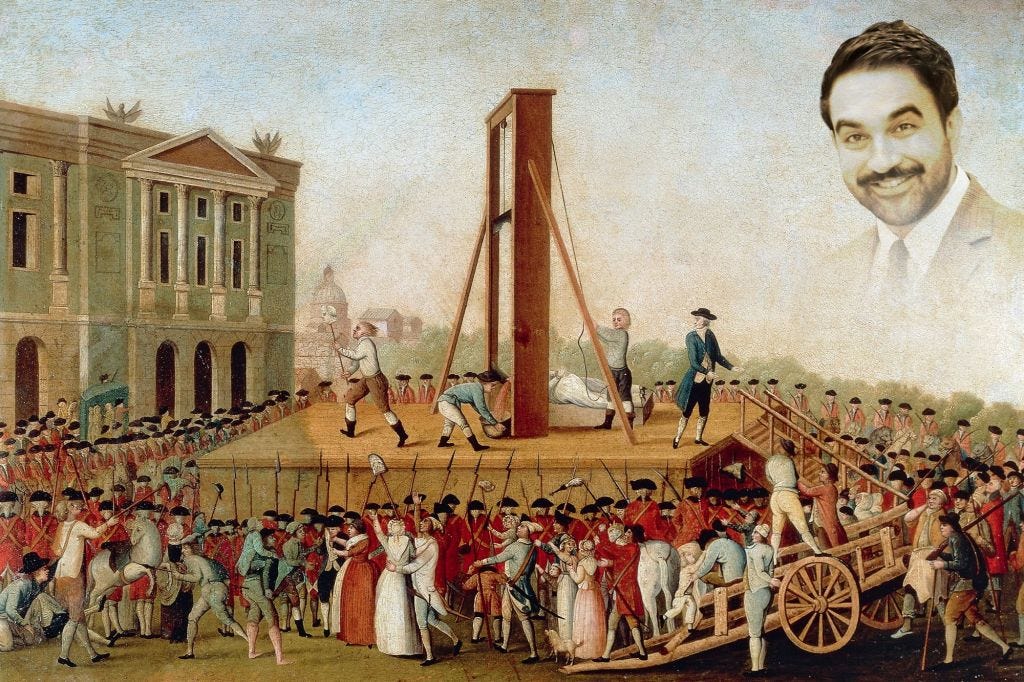
What the Times does is important, because it is the most powerful media outlet, the benchmark for all serious journalists. It choose to reverse a policy not endorse in state and local elections to join the New York Post in urging its readers not to rank Mamdani as a candidate. Meanwhile, the Post unabashedly continues to wage a propaganda war on Mamdani that is truly unhinged at times. See the image below, from a story about how Mamdani is planning a French-Revolution-style purge of the wealthy.
It is possible to cover the topic of government reform. For example, a Times story in July about his creation of a Committee on Government Efficiency, which is intended to invite a DOGE comparison, though its really about City Charter reform. In this story, you get two paragraphs that mentions (but does not name) PIT Crew and the broader governing philosophy.
Even for some critics of Mr. Mamdani, the commission is an encouraging sign of his approach to democratic socialist governance, which has tended to emphasize making the public sector run more smoothly and effectively, and more like the private sector. Mr. Mamdani has made the theme central to recent public appearances, from a news conference where he shredded papers that listed cumbersome small business regulations to another on Coney Island where he entered on a Go-Kart to announce plans to make the city’s technology run faster.
Mr. Mamdani campaigned with the notion that his spin on democratic socialism would look like “sewer socialism,” meaning a focus on small-bore public sector improvements. In his first 100 days in office, his Department of Transportation filled nearly 4,000 potholes in March and held a “Municipal Madness” bracket-style competition for New Yorkers to pick a problem for him to address. COGE is in many ways an effort to make that work longer lasting, by proposing changes to the City Charter.
This is good, and I just wish there was a lot more of it.
As a professor, there is no end of media telling me how to do my job. That makes me cautious about telling media how to do their jobs. But I do think that the energy Mamdani is pouring into the nuts and bolts of government is not based on a completely naive assumption. He sees a hunger not just for competence, but the celebration of public competence. Are New Yorkers genuinely responding to what he is doing? Or is it all just social media hype? Is it making a difference inside government at a time of federal government dysfunction? These are stories worth pursuing.
One downside of negativity bias in media coverage is that it has fed a corrosive mistrust of government, which has fueled anti-government forces who then justify that mistrust with mismanagement. We very much need a skeptical media to hold government to account and journalists are doing essential work in that department right now. And big promises of government improvement should invite real investigation of success. But we also need them to tell us when government is working well and trying to do better. Reporters don’t have to become influencers to embrace a little bit of positivity bias.
I’m not naming the reporters here because my arguments are about structures and incentives rather than individuals. This is why I would make a lousy reporter.
When he was campaigning, Mamdani reminded me of Fiorello LaGuardia. Do you know if LaGuardia was similarly focused on implementation?
I wonder if there’s also a partisan bias. There’s a lot of negative coverage and skepticism about Mamdani’s progressive agenda and it’s linked, in that coverage, to his Democratic Socialist membership. Add to that, the bias toward his name and religious faith. There’s an awful lot of pundits who hope he fails.
PS: I had to check to see what I said in response to your piece on the PIT crew. Turns out I had it bookmarked but haven’t read it yet. At least I was interested! 🙄 I did know about the PIT crew though. Maybe from Lulu Garcia Navarro’s NYTimes interview with him. She was pretty harsh with him but he smiled his way through it, quite effectively, I thought.