Colbert, courage and capitulation
New data show bipartisan opposition to government leaning on TV networks and universities

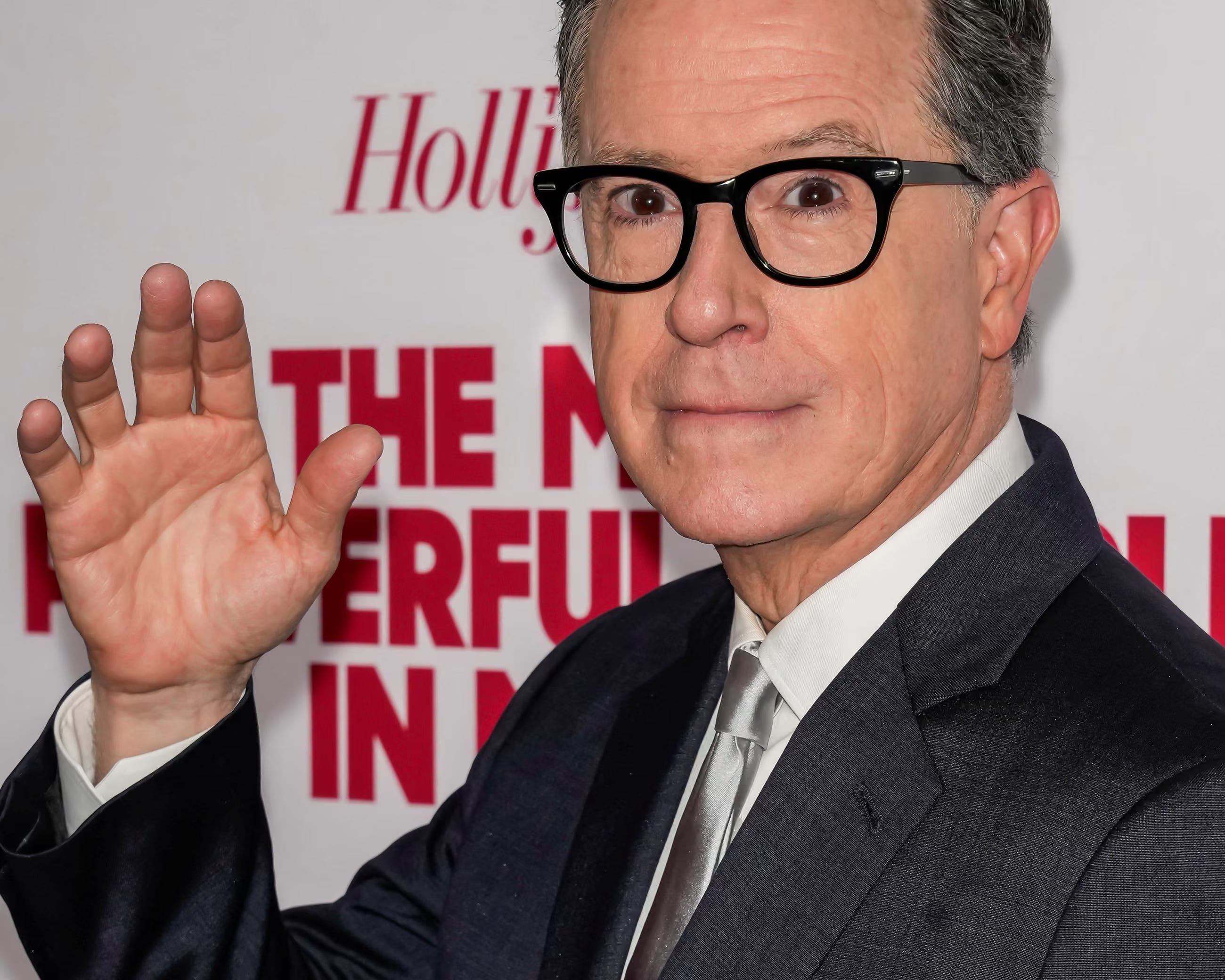
When CBS’s The Late Show with Stephen Colbert broadcasts its last episode tonight, it completes a pattern that has become distressingly familiar: an institution under government regulatory pressure publicly folds, offering financial cover for what most observers call a political decision.
What’s missing from that pattern? Any evidence the public wanted this outcome. In fact, the evidence shows the opposite.
Over the past few years, leaders in the federal and many state governments have called on late night hosts like Colbert and ABC’s Jimmy Kimmel to be fired, namely for their jokes about President Trump. President Trump advised CBS that Colbert should be “put to sleep” and called on ABC to fire Kimmel. CBS’s canceling of The Late Show came days after Colbert joked about Paramount’s $16 million lawsuit settlement with Trump and was reported to be related to the proposed merger of its parent company, Paramount, with Skydance Media.
New data from a national sample of Americans collected by Wisconsin Communication Elections Study, conducted by the Center for Communication and Civic Renewal that I direct, reveals what the public thinks.
The bottom line: three-quarters of Americans oppose government pressure on TV networks to cancel shows that satirize the powerful.
The survey of 2,000 American adults, administered by YouGov and collected in April of 2026, asked whether people think the government should or should not be able to pressure television networks to cancel shows. 74 percent opposed the idea while only seven percent supported it. The rest had views that were in the middle.
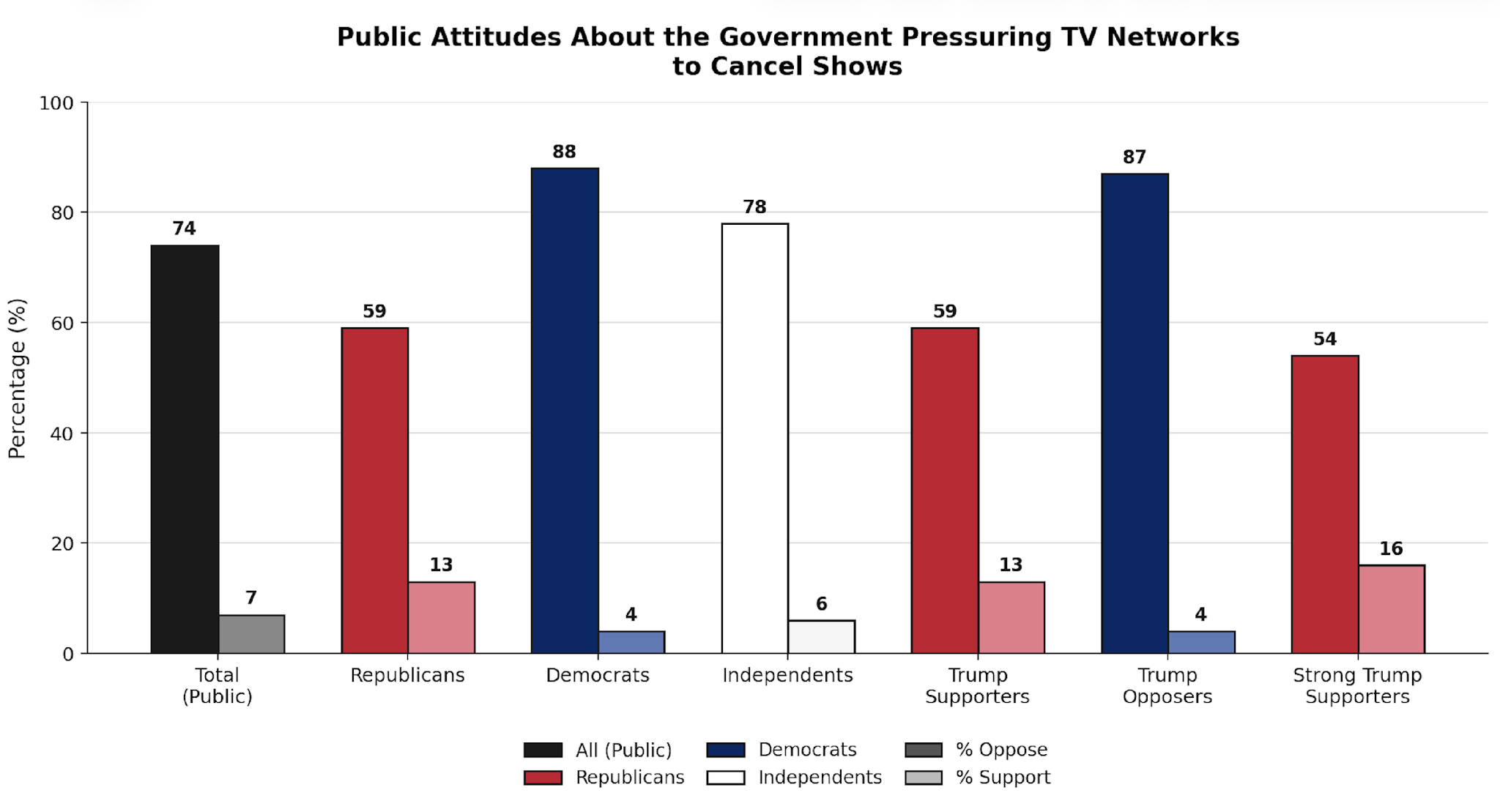
The above figure breaks down the results by political partisanship with the darker bars revealing opposition to the government being able to pressure TV networks to cancel shows and the lighter bars highlighting support for the notion. Democrats were nearly unanimous in their opposition to the idea while nearly six in ten Republicans also opposed it. Independents’ attitudes looked more like Democrats than Republicans with 78 percent opposing government pressure on networks. So while there are partisan differences in perspectives, the opposition to the Trump tactics is bipartisan.
Perhaps even more remarkably, given the high-profile nature of President Trump’s public comments on Colbert, Kimmel, and other late-night hosts, is how little support Trump has from his base on this issue. Only 16 percent of strong Trump supporters favor the idea of the government pressuring networks to change what’s available on our television sets.
The data show that this is a fringe position, even among the most ardent MAGA Republicans.
Indeed, CBS is far more likely to be angering its viewers than pleasing them by canceling The Late Show. Just as ABC faced intense public rebukes when it suspended Jimmy Kimmel in September, Colbert’s audience soared since the summer 2025 announcement of his cancellation.
And the opposition to government pressuring institutions to punish unpopular speech extends to attitudes about the government telling universities to fire professors who study or say controversial things the government does not like. That same survey found 63 percent of the public opposed to the idea that the government should be able to pressure universities to fire professors. The figure below shows that, once again, more Republicans opposed (40 percent) than supported (25 percent) the notion.
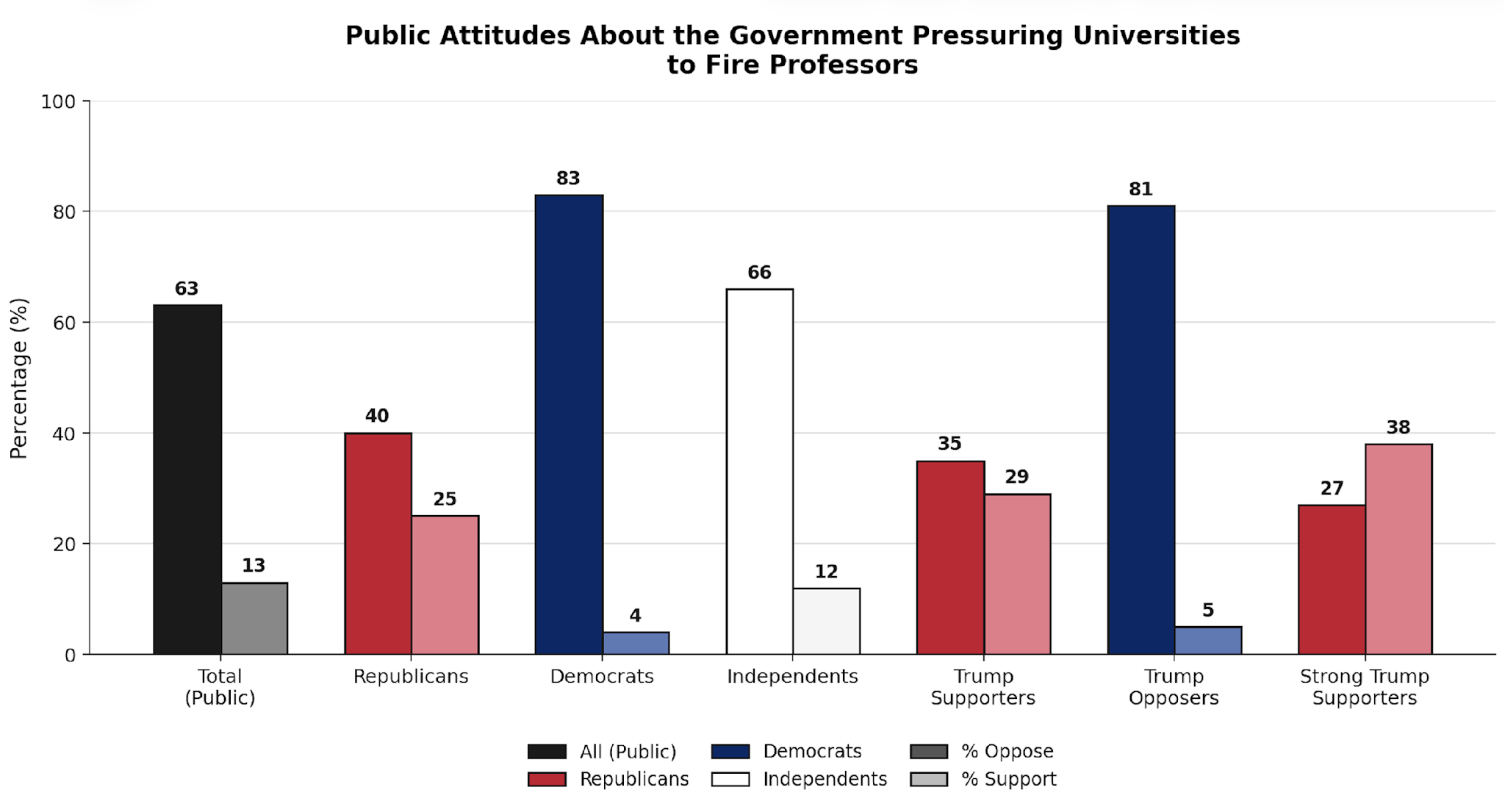
However, the president, Republicans in Congress, and many state governments have been actively attacking universities for a longer time and in a more coordinated way than the complaints about late night satirists. So, it is not surprising that there is a bit more public support for the government pushing universities to fire professors as compared to canceling TV shows. Even so, it is remarkable that the only partisan group that likes the idea of governments pushing universities to fire faculty more than they dislike the idea are strong Trump supporters. More Trump supporters, writ large, oppose the notion (35 percent) than support it (29 percent).
Once again, Independents look more like Democrats as 66 percent of people with no fidelity to either party oppose universities having to face government pressure to can faculty.
These attitudes about speech and firing aren’t isolated — they connect to broader skepticism about government interference in higher education generally. An earlier wave of the same study, conducted in April and May of 2025, asked about public support to the federal government cutting research grants at universities. Only 32 percent of American adults supported the cuts from the so-called Department of Government Efficiency, though the partisan split was much starker than it is for attitudes about political pressure on TV networks and universities.
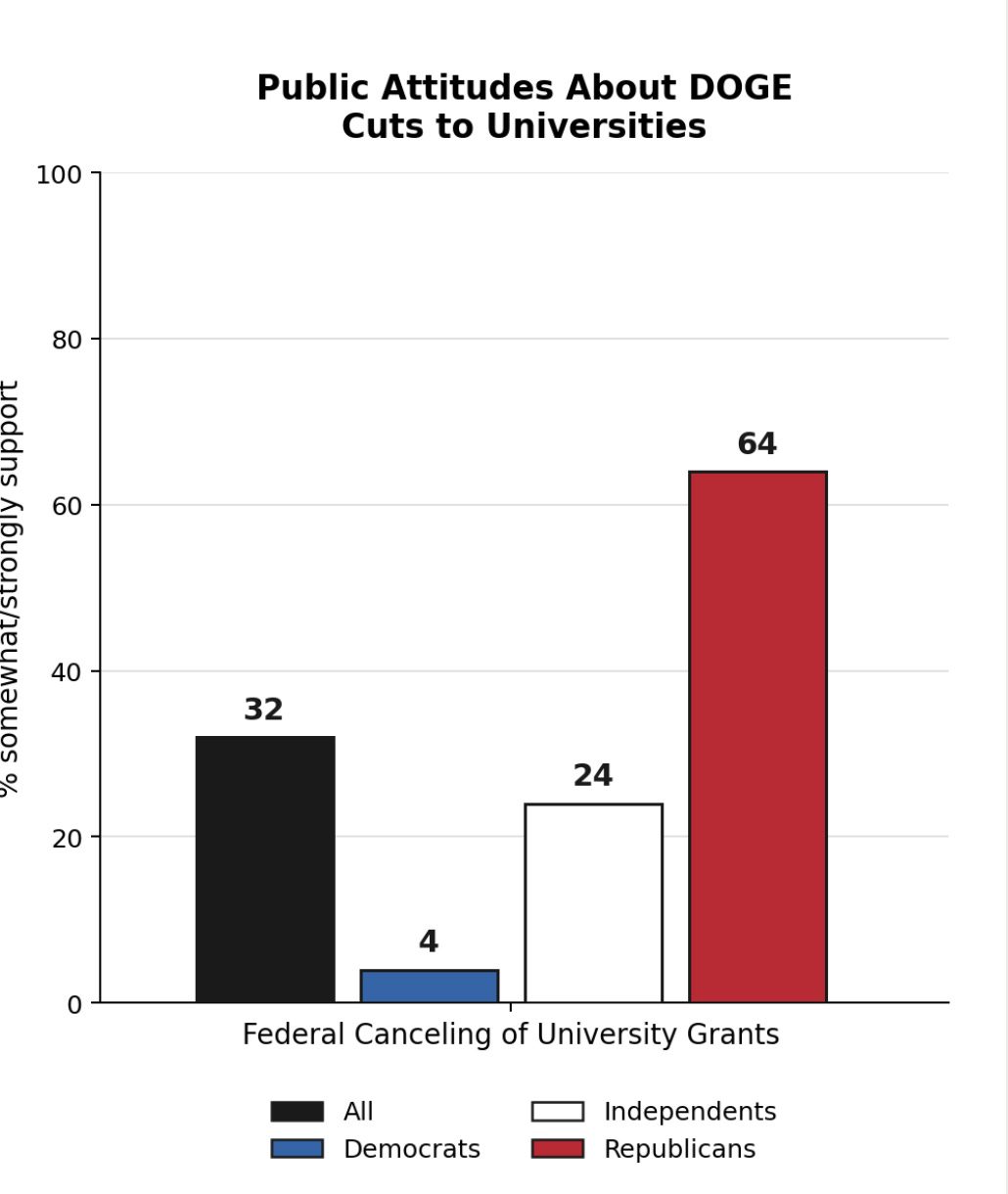
Still, it is noteworthy that decisions to fire nearly four dozen faculty across the country for their comments about the killing of conservative activist Charlie Kirk as well as the ousting of university leaders at institutions including Harvard University, Columbia University, and the University of Pennsylvania over debates on college campuses about antisemitism and protests over the war in Gaza run counter to a broad principle that most Americans expressed to us in our surveys – that the government should not be in the business of pushing some of our most important national institutions to fire people for the things that they say while doing their jobs.
As Knight First Amendment Institute at Columbia University Director Jameel Jaffer recently said, “the spirit of liberty is still easy to find in the United States, but you have to look beyond the leadership of elite institutions. Among ordinary citizens, there’s no scarcity of civic courage.”
The public’s voice is clear. Television networks, universities, and indeed all of our institutions would be well served by heeding the people’s civic courage. It is not just the right thing to do – it is backed by the public.
Michael W. Wagner is the William T. Evjue Distinguished Chair for the Wisconsin Idea at the University of Wisconsin where he directs the Center for Communication and Civic Renewal.
 | A guest post by
|
The differences between the support for government interference in TV versus higher education is interesting. My gut tells me that it goes much deeper than that higher education has been under attack for longer and by more coordinated efforts. My hunch is that those efforts tap into underlying resentments about opportunity and support vis-a-vis the families and communities who have either felt left behind or feel intimidated in some respect from not being facile at unpacking complex ideas. It’s not that they can’t, but that the language and facility of doing so is starkly different than it is for the college grads returning home. I’m considering members of my own family. Attitudes were bandied about that formed a chasm between those who went to college and those who didn’t. So, what I’m wondering is if the coordinated efforts are tapping into something that was already there. Even without that effort, I suspect the difference between support for government interference versus TV would have existed.