
One of the challenges of living in the Trump era is wondering if anyone actually believes Trump’s claim that his presidency has made America stronger and more globally respected than ever. Trump has dismantled much of the international infrastructure that America built and largely controlled, allowing it to become the dominant superpower over the last 80 years.
Of course, you might not pay attention to such things. But if you travel abroad, you can hear the deepening bewilderment, frustration, and, yes, mockery of what the US has become under Trump.
Maybe you don’t travel abroad. But you can at least look at some polls. And surveys by the Pew Research Center show that the US is now viewed less favorably than its emerging superpower rival, China, by the rest of the world.
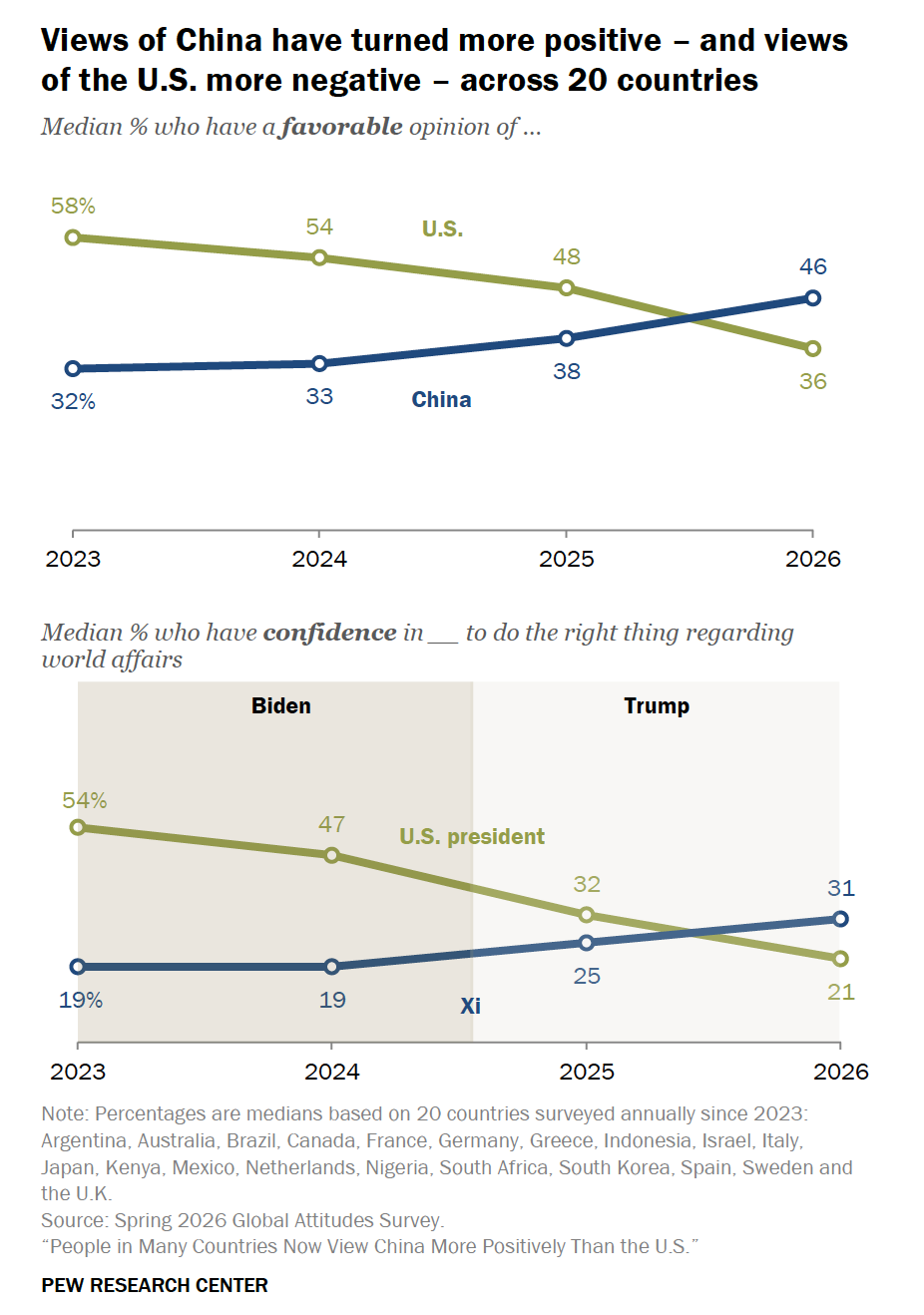
Trump’s presidency got us to the point where people in lots of countries view China more positively than the US. This is despite the fact that China remains a one-party state, run by an authoritarian who has purged rivals, is increasingly investing in its military, asserting territorial claims, and threatening countries that resist.
Chinese commentators feel increasingly bullish about the future because of Trump. In his first term, Chinese glee at Trump’s actions won him the nickname “Chuan Jianguo,” which roughly means “Trump, the (Chinese) nation builder.” Trump’s elimination of US soft-power institutions like USAID and Voice of America in his second term has compounded Chinese confidence that Trump is doing their work for them.
Lets focus on one aspect of US-Chinese competition, which is higher education and technological innovation. After all, part of China’s global appeal — in contrast to Russia, America’s erstwhile superpower rival — is that it is seen as exceptionally innovative, allowing it to build the future. Higher education is key to that progress.
Higher education is an industry that America has dominated globally, one which creates middle-class jobs across the United States that cannot be outsourced. As I’ve written before:
International students generate about forty billion dollars per year, subsidizing American students. They pay a significant tuition premium to come to the United States because our educational system is viewed as the best.
Higher education is not just a very profitable export industry. It is also a source of technological innovation, a means by which nations secure a knowledge edge over their rivals. The collapse of Germany into barbarism in the 1930s allowed America the pick of the talent from what was the leading educational system in the world up to that point. The creation of a mutually beneficial partnership between higher education and the federal government since World War II allowed America to cement its dominance in the field. Through historical timing and smart investment, America built a magnet that drew in the smartest people in the world.
Now, this is starting to fall apart because of Trump’s attacks on higher education generally and international scholars in particular. And precisely because of Trump, China sees an opportunity to become a global leader in higher education, reaping the economic benefits that follow.
I thought about this when reading “The Future, Made in China” by Evan Osnos. It is an excellent piece, detailing both the jaw-dropping pace of change, and the wariness of many Chinese people struggling to find their role amid that change.
One theme that Osnos highlights is how much leaders in China see their current rise as a function of the choices that Trump has made, in higher education and elsewhere. If JD Vance really wants to hear of chorus of “thank yous” for Donald Trump, he should go to China:
In Beijing, a think tank at Renmin University recently published an assessment titled “Thank Trump,” which wryly hailed his efforts to hasten the “twilight of an empire,” by undermining America’s alliances, civil service, scientific institutions, and democratic credibility.
One of the authors of the “Thank Trump” report, Wang Wen, asserted a growing consensus among Chinese scholars that Trump’s actions are immeasurably helping China:
His first term rattled Washington’s furniture. His second is dismantling the house. He has purged the civil service, stretched executive power, taxed friend and foe alike, and gutted America’s contribution to global public goods. He appears to be governing for the next election, not the next generation – and this is speeding up the arrival of a multipolar world…the real contest is in governance, and time is on China’s side. American policy lurches with every election. China’s five-year plans, for better or worse, tend to survive them. America still leads in technology and firepower, but we’re betting that policy continuity and industrial scale will keep narrowing the gap.
Part of that policy continuity comes in higher education investments. While Trump tries to govern Venezuela and hobble Iran and Cuba, “China is focussed on winning the technologies of the future,” said Rush Doshi, a Georgetown professor that Osnos interviewed. As Trump steps away from electric vehicles, treats climate change as a sham and invests in fossil fuels, China wins on clean energy technology. Biotech, robotics and AI are next on the list. To get there, they need to close the gap with US higher education, and Trump is helping them.
Trump’s hostility toward international students remains undiminished. He now proposes a $100,000 tax on those who want to stay in the US, the latest in a series of actions that are causing tech companies to build offices overseas to recruit talent there rather than in the US.
Chinese students and faculty have been especially targeted. In his first term, Trump launched the “China Initiative”, directing the FBI to investigate Chinese scholars. The resulting charges were unimpressive, often reflecting administrative errors or reporting failures of ties to Chinese institutions rather than actual espionage. But the cloud of suspicion ended careers and President Biden stopped the program.
With Trump back in office, the focus on Chinese scholars returns. My university, Michigan, was put under investigation after Chinese students and a Chinese professor visiting Michigan were accused of smuggling biological samples and fungi that could damage crops into the US. The charges against some were dropped, and the students allowed to return to China. In April of this year, a Chinese researcher at Michigan appeared to kill himself after questioning by federal authorities. A Chinese neurobiologist closed his lab on campus and moved it to China.
After Roger Innes, a microbiologist at Indiana University, wrote a letter of support of the Michigan students that argued that the biological material being imported was not threatening, the Chinese students in his labs were investigated, and he was locked him out of his research lab by federal order. It is not just that Chinese scholars are targeted: so too are non-Chinese scholars who push back.
Whatever you think about the merits of such investigations, the net effect is to create a hostile environment for Chinese scholars. If they are going to be surveilled, no need to come to the US: they can just stay in China for that. And increasingly, Chinese students don’t want to come to the US.
Many Chinese scholars are going home, driven by a mixture of US hostility and Chinese recruitment. A study of the effect of Chinese scientific migration, undertaken before Trump’s second term in office, suggested that about 20,000 Chinese scientists left America between 2010 and 2021. The authors wrote:
Our study reveals the widespread fear among scientists of Chinese descent in the United States arising from conducting routine research and academic activities. If this fear is not alleviated, there are significant risks of underutilization of scientific talent as well as losing scientific talent to China and other countries.
If the purpose of the China Initiative was to stop the flow of knowledge between the US and China, it backfired spectacularly by playing into the hands of Chinese institutions trying to recruit. The rate of departures saw with a 75% increase exits after the China Initiative was launched. In 2004 just 31 Chinese scholars returned to China in 2004, increasing to 1,409 in 2022.
New research documents both the type of scholars who exit, who tend to be stronger than peers, and their effects, which is to improve the performance of their new colleagues in China. Being connected to a returning scholar is:
associated with research-quality gains among local scholars, broader research participation, and greater frontier output at receiving institutions. These knowledge spillovers show that high-skilled migration generates value not only by reallocating talent, but also by reshaping local research networks and institutional environments.
Within China, Osnos reports that Trump’s actions resolved an internal debate on how much to invest in science, causing the CCP to strive toward “scientific and technological self-reliance.” While China still spends less on science than the US, it has committed to spending more than 7% of its GDP at a time when US federal R&D spending has been on a downward trajectory, and the Trump administration has buried research awards under byzantine politicized processes.
One of the returning scientists Osnos interviewed, Yi Rao, left Northwestern to become Dean of Peking University’s School of Life Sciences. He assessed Trump’s policies bluntly:
“It’s very stupid,” he said. “Invention doesn’t come out of the blue.” He gave an example: if the U.S. reduces funding for cancer research, “it would now be natural that China might invent a cancer vaccine before the U.S.”….“The current world order was built by a group of geniuses, mainly in the U.S., who hailed from Europe,” Rao said. “If Trump had maintained the order effectively, China would find it very hard to get through. Trump really helped us.”
China’s aggressive recruitment extends beyond Chinese scholars. A 2025 Nobel Prize winner in chemistry, Omar Yaghi, moved to China to lead an AI lab. Yaghi is an immigrant to the US, the son of Palestinian refugees who grew up in Jordan. In the 21st century, such immigrants make up 40% of America’s Nobel Prize wins in chemistry, medicine, and physics. Will they keep coming to the US?
Rebuilding Does Not Mean Copying China
China’s success comes with complications, caveats and reasons for US optimism if only America can right its ship.
Historically, researchers have bristled against and been less successful working under authoritarian systems where they cannot say what they like and have to match their work to political agendas. The problem is that the US no longer feels like the clear winner on these grounds.
Before he received the Nobel Prize, Yaghi described his concern about the destructive nature of Trump’s policies to American innovation.
I think it’s regrettable. We’ve learned over and over in human civilization that scholars can move across borders. This is how knowledge spread and how vast regions of the world lifted themselves out of poverty….We have to know that people coming from different backgrounds improve the level for everybody involved. That’s an amazing story. Great thinkers can improve not only the U.S. but the world.
The good news is the damage to US science is real, but not irreversible. The infrastructure built over by generations of a federal-higher ed partnership is battered but intact.
And that infrastructure has inherent advantages over a system built under a one-party state unwilling to allow much internal criticism. American scientific traditions incorporate broader ways of knowing than the type of STEM-centric approach that China is pursuing, ways of knowing that can better serve society. China’s faith in engineering has enabled great achievements, but its record on social engineering is dismal, resulting in famines in the past, and all-encompassing surveillance today.
As Osnos notes, China’s “one-child” policy was pushed persuasively by engineers, but would have benefited immeasurably from some social science insight into the consequences. Today, even as China is building the future, it cannot convince its citizens that the future is bright enough that it is worth having children. China’s birth rate recently fell to a 76 year low, significantly lagging the US.
While it would be tempting for policymakers to replicate China’s monomaniacal focus on STEM (and Trump’s downsized science agenda pivots from social science to initiatives like AI), this would be repeating China’s blind spots. What gave US-based scholarship its strength was its diversity of interests.
For example, Henry Farrell argues that the social sciences arose from and are designed to make sense of moments of great social upheaval, which is exactly the moment AI is creating right now. Focusing only on investing in AI technology, without understanding the deeper implications of the changes it brings, would be a deep failure of science.
Farrell quotes Alondra Nelson, who has been thinking carefully about the impacts of AI for years:
AI is not an external force acting upon society from outside but an internal phenomenon constituted through social processes, institutional choices, market dynamics, and political struggles. Its effects are neither uniform nor preordained. They vary with context, design, and the distribution of power that determines how these technologies are built, deployed, and contested.
This sort of dexterity that thinking reflects intellectual traditions that never saw science as just about technology, but also about how we want to live our lives. Such research is increasingly out of favor under Trump, but it is precisely the type of research that we need to govern more wisely in the future.
It is very tempting to blame the American people for the horrors of the Trump administration; after all, they elected him twice.
But our elections themselves must share a good deal of the blame, and not only because of the distortions of the Electoral College, though certainly that is part of the problem, as is Gerrymandering and voter-suppression efforts such as forcing there to be long lines at the polls and careless stripping of voters from eligible voter lists.
But an even more insidious problem is the two-party system itself. We restrict ballot access severely in order to avoid real competition in our elections, arguably this is to avoid the fundamental flaws of plurality election when faced with more than only two candidates.
But there is a voting system that, together with relaxing these ballot access limitations, will put an end to the two-party limitation. It is called balanced approval voting (BAV). And your help is needed to raise the awareness about the opportunity it represents.
https://www.dropbox.com/scl/fi/twkgsgy76484spmmpy2dx/A-Vote-Against.pdf?rlkey=4o7cnrz6zzsyfkrmfdcqgai70&dl=0
This is a brilliant summary of why and how the Trump damage to US higher ed is so dreadful. The combination of anti-science and anti-immigrant policies cripples our entire economy but the earliest and deepest effects are felt in our educational systems, especially in higher ed. William Kirby’s Empires of Ideas argued (preTrump2) that the 19th century was German until Hitler turned the lights out, the 20th century was American because we turned them on, invited people in and invested real money. Both people and ideas came to the US as they had once come to Germany, and German higher ed stagnated and shrank in significance. He predicted the 21st century was looking more and more Chinese, though restricted in competing with the US (despite investments and innovations and institutional growth) because it was more authoritarian and less inclusive of social sciences and qualitative methods of learning in general. Linguistic barriers are higher and freedom of movement (of people and money) less.
So his bet on China out competing us was not strong, and his encouragement to make US access greater (less costly) and more attuned to the meeting the demands of global dimensions of living (from climate crises to fluency in multiple languages). But T2 has taken us at high speed in the opposite direction gleefully handing every advantage away and attacking the remaining strengths of higher ed systems (their efforts to be institutIonally diverse and serve the needs of diverse populations, both domestic and international; their freedom of thought and debate; their very unruliness).
You’re all too right. China wins, we lose. And following Kirby, I suggest that a century is the likely timeline. Maybe the 22nd century will be ours? Maybe the EU will have the diversity, resources, imagination and openness for it to be theirs? Not a bad outcome, if it comes to that. But sad to see so many US resources squandered and lives destroyed in this century.